I’ve been a fan of Japanese whisky for a long time (after overcoming my initial read that they were soulless), but I have struggled to get my head around all the category. So, with some help from ChatGPT, I decided to build myself a practical framework for understanding Japanese whisky. The goal is orientation rather than bottle collecting. My hope is to help you (and myself) to walk into a bar or shop, taste something once, and have a rough sense of where it fits.
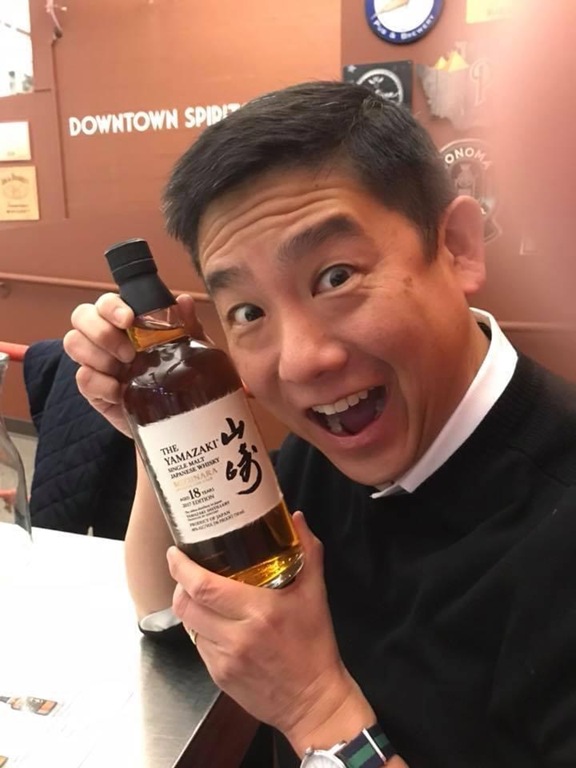
(Me with the rare bottle of Yamazaki 18 Mizunara. Delicious.)
First principles
Japanese whisky begins with Scotch technique but diverges in emphasis. It consistently favors balance over extremes, precision over power, and blending as a first class craft rather than a compromise. It is also meant to be a daily drink, not only a contemplative one reserved for special occasions.
If bourbon tends to emphasize sweetness, new oak, and immediate impact, and Scotch often emphasizes regional character, Japanese whisky emphasizes balance and integration, meaning how parts are chosen and assembled to work together.
One important caveat is that, for most of its modern history, there were effectively no formal legal rules defining what could be called Japanese whisky. Unlike Scotch, there was no long standing requirement that it be distilled, aged, or even fully produced in Japan. For years, some bottlings labeled as Japanese whisky included imported spirit or were distilled overseas and blended domestically. This does not mean those whiskies were bad, but it does mean the label alone was not a guarantee of origin. In 2021, The Japan Spirits & Liqueurs Makers Association published standards for labeling Japanese whisky, but the category is still better understood by producer reputation than by regulation. (Basically, the raw ingredients must be limited to cereal grains and water extracted in Japan, malted grains must always be used, fermentation/distillation need to take place in Japan, must be wood cask aged in Japan for at least three years, and bottling can only take place in Japan. Plain caramel coloring can be used.)
The framework
When tasting any Japanese whisky, three questions do most of the work. The first is how light or weighty the whisky feels, which speaks to body and structure. The second is how clean or smoky it is, which describes the overall flavor shape rather than specific tasting notes. The third is how it seems to be meant to be used, whether that is neat, with water, or in a highball.
The two pillars: Suntory and Nikka
Nearly everything a newcomer encounters traces back to two houses, Suntory and Nikka. Understanding how each organizes its distilleries and bottlings explains most of the category.
Suntory is generally elegant and restrained, with a strong emphasis on harmony. Its oldest and most famous malt distillery is Yamazaki, located near Kyoto. Yamazaki produces layered, classical whiskies built around fruit, spice, and oak. In the United States, the most commonly encountered expression is Yamazaki Distiller’s Reserve, with Yamazaki 12 Year appearing regularly in some markets but often at higher prices and in allocated quantities. Older age statements appear sporadically and at much higher prices. (I love the Yamazaki 18 and especially the Yamazaki 18 Mizunara, but those are hard to find and expensive.)
Suntory’s second malt distillery is Hakushu, set in a forested mountain environment. Hakushu whiskies tend to be fresh, herbal, and lightly smoky, with a bright, almost alpine character. Hakushu Distiller’s Reserve is generally the most consistently available Hakushu expression in the US market, while Hakushu 12 Year appears in waves depending on distribution and allocation.
Suntory also operates the Chita distillery, which produces grain whisky rather than malt. Chita whisky is clean, soft, and structural. It rarely takes center stage on its own in the United States, although The Chita Single Grain does appear occasionally. Its more important role is as the grain backbone of Suntory’s blends.
That brings us to Suntory’s house bottlings. Hibiki Japanese Harmony is not tied to a single distillery. It is a system level blend built primarily from Yamazaki and Hakushu malt whiskies, rounded and integrated with Chita grain whisky. The goal is balance rather than site expression. Suntory Toki is also a blend, but with a different intent. It leans more heavily on Hakushu malt for freshness, supported by Yamazaki for structure and Chita grain for smoothness. Toki is explicitly designed for highballs and everyday drinking.
Nikka, by contrast, tends to be firmer and more muscular, with a posture that often feels closer to Scotch. Nikka’s Yoichi distillery is located on the coast of Hokkaido and produces weightier whiskies with peat and maritime influence. Yoichi Single Malt is the flagship expression most commonly seen in the US.
Nikka’s other main malt distillery is Miyagikyo, located inland in a river valley. Miyagikyo whiskies are softer and fruit driven, with rounded edges and a more polished feel. Miyagikyo Single Malt is widely available and serves as a counterpoint to Yoichi.
Nikka also produces grain and malt whiskies on Coffey stills, which are continuous stills rather than pot stills. Both Nikka Coffey Malt and Nikka Coffey Grain are distilled primarily at Miyagikyo. Coffey Malt uses malted barley but has the texture and sweetness people associate with grain whisky, while Coffey Grain is made largely from corn and often feels bourbon adjacent. Nikka Coffey Malt is one of my favorite everyday drams. The Nikka Whisky from the Barrel blended whisky is also a personal go-to.
A simple taxonomy
Before going further, it helps to understand why Japanese whisky suddenly became scarce and expensive. Around the early 2010s, roughly 2013, Japanese whisky experienced a sharp spike in global attention and demand. International awards, enthusiastic Western press, and a few high profile bottlings combined to push Japanese whisky from a domestic staple into an international luxury object. The problem was that whisky being sold in 2013 had been distilled a decade or more earlier, at a time when producers had scaled down production due to low domestic demand. The resulting mismatch between supply and demand emptied warehouses quickly.
The effects are still visible today. Age statements disappeared, prices climbed, and many whiskies that were once everyday bottles in Japan became export constrained. Understanding this history helps set expectations. Japanese whisky was not designed to be rare. It became rare because it was unexpectedly successful.
Another way to say this, without introducing new rules, is that Japanese producers think in terms of function rather than hierarchy. Single malts tend to express place, such as Yamazaki, Hakushu, Yoichi, and Miyagikyo. Grain whiskies tend to provide structure and continuity, with Chita on the Suntory side and Coffey Grain or Coffey Malt on the Nikka side. House blends tend to express intent, bringing components together to achieve a specific balance or use case, as seen in Hibiki, Toki, and Nikka From the Barrel.
An orientation map
Rather than scores or rankings, it is more useful to think of Japanese whisky along two simple axes. One runs from light to weighty and describes body. The other runs from clean to smoky and describes overall flavor shape.
On the lighter and cleaner end sit bottles like Suntory Toki and Nikka Days, which emphasize refreshment and ease. Hakushu Distiller’s Reserve still feels light but introduces more character through herbs and a trace of smoke. Yamazaki Distiller’s Reserve and Hibiki Harmony occupy the middle ground, with moderate body and a generally clean profile. Yamazaki 12 sits just above that midpoint, adding more depth, oak integration, and length without moving far toward smoke. Hakushu 12 adds more smoke without becoming heavy. Miyagikyo Single Malt moves toward the weightier side while remaining relatively clean, while Yoichi Single Malt sits at the weighty and smoky end of the spectrum.
Mizunara oak
Mizunara oak plays a specific and often misunderstood role in Japanese whisky. Mizunara is a species of Japanese oak, native to Japan, and distinct from the American and European oak more commonly used in whisky making elsewhere. It is extremely porous, difficult to season, and prone to leaking, which makes it expensive and frustrating for distillers to work with.
When it works, Mizunara contributes aroma more than structure. It can suggest sandalwood, incense, coconut husk, old wood, or temple like notes that are closely associated with Japanese whisky in the popular imagination. These characteristics tend to emerge slowly and are often most apparent after long aging. Because of its fragility and assertive aromatic profile, Mizunara is rarely used as the sole maturation vessel. In most cases it appears as a component or finishing element rather than a foundation, adding a distinctive accent rather than defining the entire whisky. I personally love Mizunara aged whisky. Bainbridge Organic Distillers here on Bainbridge Island, WA (where I live) uses mizunara extremely well. Their Yama is the only non-Japanese whisky aged exclusively in Mizunara oak and is an exceptional bottle. They also make a really great bottle called Two Islands Mizunara Cask Whiskey, which has a second aging in single-use Mizunara casks (and is much less expensive than the Yama.)
A note on modern brand‑led Japanese whisky
As Japanese whisky gained global attention and legacy producers ran into hard limits on mature stock, a parallel category emerged alongside the traditional distillery system. These are brand‑led Japanese whiskies that emphasize sourcing, blending, maturation, and finishing choices rather than the voice of a single distillery. Whiskies such as Shibui, Sensei, Kurayoshi, and The Mikuni fit here.
These bottlings are best read as expressions of intent rather than place. They are typically built to be approachable, export‑friendly, and stylistically legible as “Japanese,” often leaning on polish, balance, and, at times, Japanese oak as a signal. That does not make them illegitimate, nor does it place them in competition with Yamazaki, Yoichi, Komagatake, or Chichibu. They are answering a different question. Instead of asking what a particular site tastes like, they ask what Japanese whisky should feel like to a global drinker.
Understanding this distinction prevents confusion. Distillery‑anchored whiskies teach you geography, climate, and production philosophy. Brand‑led whiskies teach you how Japanese whisky aesthetics have been translated outward as the category expanded. Seeing them as complementary rather than interchangeable makes the modern Japanese whisky landscape far easier to navigate.
The highball
A highball is a simple mixed drink made by combining whisky with chilled carbonated soda water over ice, usually in a tall glass. In Japan, highballs are central to whisky culture rather than secondary, and understanding how they are actually drunk changes how Japanese whisky itself makes sense. In Japan, the highball often plays the social role that beer plays elsewhere. It is refreshing, low friction, and meant to be consumed with food, conversation, and repetition rather than contemplation. In that sense, yes, it functions very much as a beer replacement, especially in izakaya and casual bars where people might drink several over the course of an evening. We’re big fans of Toki highballs in my household.
A standard Japanese highball is more precise than it looks. Ratios are usually conservative, often somewhere between one part whisky to three or four parts soda, depending on the house style and the weight of the whisky. The glass is fully chilled, the ice is hard and clear to minimize dilution, and the soda is added gently to preserve carbonation. Many bars use strongly carbonated soda water such as Suntory Soda, Wilkinson, or similarly aggressive carbonation. The goal is lift and snap rather than sweetness.
A thin lemon slice or lemon peel is common but not universal. When used, it is meant to brighten aroma rather than turn the drink into a citrus cocktail. The lemon is usually expressed lightly or simply dropped in, never muddled. Some bars omit citrus entirely for cleaner whiskies, especially Hakushu based highballs, where freshness comes from the malt itself.
At the higher end, the highball becomes a study in restraint rather than extravagance. Better bars adjust ratios slightly upward, use hand cut ice, and choose whiskies with enough structure to survive dilution. Yamazaki, Hakushu 12, or even Hibiki are sometimes used, not to show off but to demonstrate how balance changes when stretched. In these cases, the drink is often stirred once or twice and left alone.
At the higher end, another common way of drinking whisky appears alongside the highball, known as mizuwari, which is simply whisky diluted with still water, often close to a one to one ratio. This is not about weakening the whisky but about opening it. Dilution lowers alcohol heat, releases aroma, and makes it possible to drink whisky slowly over a meal. Good bars adjust the ratio by feel, often adding water first, then whisky, and stirring gently to integrate rather than shock the spirit. Mizuwari is especially common with more structured whiskies like Yamazaki or Yoichi, where added water reveals fruit, spice, and texture that can be obscured when tasted neat. In colder months, some drinkers switch to oyuwari, which uses hot water instead of cold to emphasize aroma and softness, particularly with fuller bodied whiskies.
Suntory Toki, Hakushu Distiller’s Reserve, and Nikka Days all excel in highballs, and they were designed with this role in mind. Suntory even deploys dedicated Toki highball machines that pre‑chill, carbonate, and ratio the drink consistently, reinforcing the idea that the highball is engineered rather than improvised.
Judging these whiskies only when tasted neat misses an essential part of what they are meant to do.
A practical starting point
For fast calibration, a small set of bottles goes a long way. Toki establishes a highball baseline. Yamazaki Distiller’s Reserve shows a clean, composed single malt. Hakushu Distiller’s Reserve introduces freshness and light smoke. Yoichi provides a Scotch-adjacent anchor. Hibiki Harmony demonstrates Japanese blending at its most polished. Nikka From the Barrel shows what happens when that restraint is turned up a notch.
What are your favorites? Share your tasting notes in the comments!