A Japanese Whisky Primer

I’ve been a fan of Japanese whisky for a long time (after overcoming my initial read that they were soulless), but I have struggled to get my head around all the category. So, with some help from ChatGPT, I decided to build myself a practical framework for understanding Japanese whisky. The goal is orientation rather than bottle collecting. My hope is to help you (and myself) to walk into a bar or shop, taste something once, and have a rough sense of where it fits.

(Me with the rare bottle of Yamazaki 18 Mizunara. Delicious.)
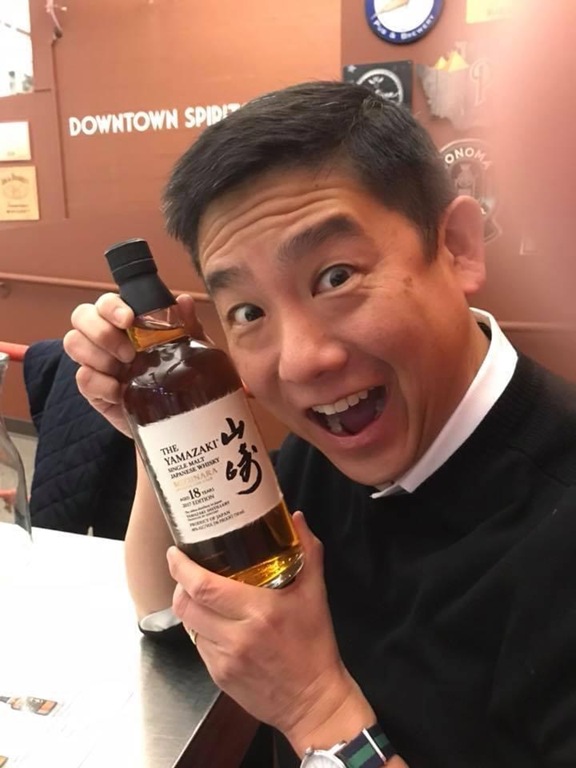
Tony with a big smile, holding a bottle of Yamazaki 18 Mizunara

First principles

Japanese whisky begins with Scotch technique but diverges in emphasis. It consistently favors balance over extremes, precision over power, and blending as a first class craft rather than a compromise. It is also meant to be a daily drink, not only a contemplative one reserved for special occasions.

If bourbon tends to emphasize sweetness, new oak, and immediate impact, and Scotch often emphasizes regional character, Japanese whisky emphasizes balance and integration, meaning how parts are chosen and assembled to work together.

One important caveat is that, for most of its modern history, there were effectively no formal legal rules defining what could be called Japanese whisky. Unlike Scotch, there was no long standing requirement that it be distilled, aged, or even fully produced in Japan. For years, some bottlings labeled as Japanese whisky included imported spirit or were distilled overseas and blended domestically. This does not mean those whiskies were bad, but it does mean the label alone was not a guarantee of origin. In 2021, The Japan Spirits & Liqueurs Makers Association published standards for labeling Japanese whisky, but the category is still better understood by producer reputation than by regulation. (Basically, the raw ingredients must be limited to cereal grains and water extracted in Japan, malted grains must always be used, fermentation/distillation need to take place in Japan, must be wood cask aged in Japan for at least three years, and bottling can only take place in Japan. Plain caramel coloring can be used.)

The framework

When tasting any Japanese whisky, three questions do most of the work. The first is how light or weighty the whisky feels, which speaks to body and structure. The second is how clean or smoky it is, which describes the overall flavor shape rather than specific tasting notes. The third is how it seems to be meant to be used, whether that is neat, with water, or in a highball.

The two pillars: Suntory and Nikka

Nearly everything a newcomer encounters traces back to two houses, Suntory and Nikka. Understanding how each organizes its distilleries and bottlings explains most of the category.

Suntory is generally elegant and restrained, with a strong emphasis on harmony. Its oldest and most famous malt distillery is Yamazaki, located near Kyoto. Yamazaki produces layered, classical whiskies built around fruit, spice, and oak. In the United States, the most commonly encountered expression is Yamazaki Distiller’s Reserve, with Yamazaki 12 Year appearing regularly in some markets but often at higher prices and in allocated quantities. Older age statements appear sporadically and at much higher prices. (I love the Yamazaki 18 and especially the Yamazaki 18 Mizunara, but those are hard to find and expensive.)

Suntory’s second malt distillery is Hakushu, set in a forested mountain environment. Hakushu whiskies tend to be fresh, herbal, and lightly smoky, with a bright, almost alpine character. Hakushu Distiller’s Reserve is generally the most consistently available Hakushu expression in the US market, while Hakushu 12 Year appears in waves depending on distribution and allocation.

Suntory also operates the Chita distillery, which produces grain whisky rather than malt. Chita whisky is clean, soft, and structural. It rarely takes center stage on its own in the United States, although The Chita Single Grain does appear occasionally. Its more important role is as the grain backbone of Suntory’s blends.

That brings us to Suntory’s house bottlings. Hibiki Japanese Harmony is not tied to a single distillery. It is a system level blend built primarily from Yamazaki and Hakushu malt whiskies, rounded and integrated with Chita grain whisky. The goal is balance rather than site expression. Suntory Toki is also a blend, but with a different intent. It leans more heavily on Hakushu malt for freshness, supported by Yamazaki for structure and Chita grain for smoothness. Toki is explicitly designed for highballs and everyday drinking.

Nikka, by contrast, tends to be firmer and more muscular, with a posture that often feels closer to Scotch. Nikka’s Yoichi distillery is located on the coast of Hokkaido and produces weightier whiskies with peat and maritime influence. Yoichi Single Malt is the flagship expression most commonly seen in the US.

Nikka’s other main malt distillery is Miyagikyo, located inland in a river valley. Miyagikyo whiskies are softer and fruit driven, with rounded edges and a more polished feel. Miyagikyo Single Malt is widely available and serves as a counterpoint to Yoichi.

Nikka also produces grain and malt whiskies on Coffey stills, which are continuous stills rather than pot stills. Both Nikka Coffey Malt and Nikka Coffey Grain are distilled primarily at Miyagikyo. Coffey Malt uses malted barley but has the texture and sweetness people associate with grain whisky, while Coffey Grain is made largely from corn and often feels bourbon adjacent. Nikka Coffey Malt is one of my favorite everyday drams. The Nikka Whisky from the Barrel blended whisky is also a personal go-to.

A simple taxonomy

Before going further, it helps to understand why Japanese whisky suddenly became scarce and expensive. Around the early 2010s, roughly 2013, Japanese whisky experienced a sharp spike in global attention and demand. International awards, enthusiastic Western press, and a few high profile bottlings combined to push Japanese whisky from a domestic staple into an international luxury object. The problem was that whisky being sold in 2013 had been distilled a decade or more earlier, at a time when producers had scaled down production due to low domestic demand. The resulting mismatch between supply and demand emptied warehouses quickly.

The effects are still visible today. Age statements disappeared, prices climbed, and many whiskies that were once everyday bottles in Japan became export constrained. Understanding this history helps set expectations. Japanese whisky was not designed to be rare. It became rare because it was unexpectedly successful.

Another way to say this, without introducing new rules, is that Japanese producers think in terms of function rather than hierarchy. Single malts tend to express place, such as Yamazaki, Hakushu, Yoichi, and Miyagikyo. Grain whiskies tend to provide structure and continuity, with Chita on the Suntory side and Coffey Grain or Coffey Malt on the Nikka side. House blends tend to express intent, bringing components together to achieve a specific balance or use case, as seen in Hibiki, Toki, and Nikka From the Barrel.

An orientation map

Rather than scores or rankings, it is more useful to think of Japanese whisky along two simple axes. One runs from light to weighty and describes body. The other runs from clean to smoky and describes overall flavor shape.

On the lighter and cleaner end sit bottles like Suntory Toki and Nikka Days, which emphasize refreshment and ease. Hakushu Distiller’s Reserve still feels light but introduces more character through herbs and a trace of smoke. Yamazaki Distiller’s Reserve and Hibiki Harmony occupy the middle ground, with moderate body and a generally clean profile. Yamazaki 12 sits just above that midpoint, adding more depth, oak integration, and length without moving far toward smoke. Hakushu 12 adds more smoke without becoming heavy. Miyagikyo Single Malt moves toward the weightier side while remaining relatively clean, while Yoichi Single Malt sits at the weighty and smoky end of the spectrum.

Mizunara oak

Mizunara oak plays a specific and often misunderstood role in Japanese whisky. Mizunara is a species of Japanese oak, native to Japan, and distinct from the American and European oak more commonly used in whisky making elsewhere. It is extremely porous, difficult to season, and prone to leaking, which makes it expensive and frustrating for distillers to work with.

When it works, Mizunara contributes aroma more than structure. It can suggest sandalwood, incense, coconut husk, old wood, or temple like notes that are closely associated with Japanese whisky in the popular imagination. These characteristics tend to emerge slowly and are often most apparent after long aging. Because of its fragility and assertive aromatic profile, Mizunara is rarely used as the sole maturation vessel. In most cases it appears as a component or finishing element rather than a foundation, adding a distinctive accent rather than defining the entire whisky. I personally love Mizunara aged whisky. Bainbridge Organic Distillers here on Bainbridge Island, WA (where I live) uses mizunara extremely well. Their Yama is the only non-Japanese whisky aged exclusively in Mizunara oak and is an exceptional bottle. They also make a really great bottle called Two Islands Mizunara Cask Whiskey, which has a second aging in single-use Mizunara casks (and is much less expensive than the Yama.)

A note on modern brand‑led Japanese whisky

As Japanese whisky gained global attention and legacy producers ran into hard limits on mature stock, a parallel category emerged alongside the traditional distillery system. These are brand‑led Japanese whiskies that emphasize sourcing, blending, maturation, and finishing choices rather than the voice of a single distillery. Whiskies such as Shibui, Sensei, Kurayoshi, and The Mikuni fit here.

These bottlings are best read as expressions of intent rather than place. They are typically built to be approachable, export‑friendly, and stylistically legible as “Japanese,” often leaning on polish, balance, and, at times, Japanese oak as a signal. That does not make them illegitimate, nor does it place them in competition with Yamazaki, Yoichi, Komagatake, or Chichibu. They are answering a different question. Instead of asking what a particular site tastes like, they ask what Japanese whisky should feel like to a global drinker.

Understanding this distinction prevents confusion. Distillery‑anchored whiskies teach you geography, climate, and production philosophy. Brand‑led whiskies teach you how Japanese whisky aesthetics have been translated outward as the category expanded. Seeing them as complementary rather than interchangeable makes the modern Japanese whisky landscape far easier to navigate.

The highball

A highball is a simple mixed drink made by combining whisky with chilled carbonated soda water over ice, usually in a tall glass. In Japan, highballs are central to whisky culture rather than secondary, and understanding how they are actually drunk changes how Japanese whisky itself makes sense. In Japan, the highball often plays the social role that beer plays elsewhere. It is refreshing, low friction, and meant to be consumed with food, conversation, and repetition rather than contemplation. In that sense, yes, it functions very much as a beer replacement, especially in izakaya and casual bars where people might drink several over the course of an evening. We’re big fans of Toki highballs in my household.

A standard Japanese highball is more precise than it looks. Ratios are usually conservative, often somewhere between one part whisky to three or four parts soda, depending on the house style and the weight of the whisky. The glass is fully chilled, the ice is hard and clear to minimize dilution, and the soda is added gently to preserve carbonation. Many bars use strongly carbonated soda water such as Suntory Soda, Wilkinson, or similarly aggressive carbonation. The goal is lift and snap rather than sweetness.

A thin lemon slice or lemon peel is common but not universal. When used, it is meant to brighten aroma rather than turn the drink into a citrus cocktail. The lemon is usually expressed lightly or simply dropped in, never muddled. Some bars omit citrus entirely for cleaner whiskies, especially Hakushu based highballs, where freshness comes from the malt itself.

At the higher end, the highball becomes a study in restraint rather than extravagance. Better bars adjust ratios slightly upward, use hand cut ice, and choose whiskies with enough structure to survive dilution. Yamazaki, Hakushu 12, or even Hibiki are sometimes used, not to show off but to demonstrate how balance changes when stretched. In these cases, the drink is often stirred once or twice and left alone.

At the higher end, another common way of drinking whisky appears alongside the highball, known as mizuwari, which is simply whisky diluted with still water, often close to a one to one ratio. This is not about weakening the whisky but about opening it. Dilution lowers alcohol heat, releases aroma, and makes it possible to drink whisky slowly over a meal. Good bars adjust the ratio by feel, often adding water first, then whisky, and stirring gently to integrate rather than shock the spirit. Mizuwari is especially common with more structured whiskies like Yamazaki or Yoichi, where added water reveals fruit, spice, and texture that can be obscured when tasted neat. In colder months, some drinkers switch to oyuwari, which uses hot water instead of cold to emphasize aroma and softness, particularly with fuller bodied whiskies.

Suntory Toki, Hakushu Distiller’s Reserve, and Nikka Days all excel in highballs, and they were designed with this role in mind. Suntory even deploys dedicated Toki highball machines that pre‑chill, carbonate, and ratio the drink consistently, reinforcing the idea that the highball is engineered rather than improvised.

Judging these whiskies only when tasted neat misses an essential part of what they are meant to do.

A practical starting point

For fast calibration, a small set of bottles goes a long way. Toki establishes a highball baseline. Yamazaki Distiller’s Reserve shows a clean, composed single malt. Hakushu Distiller’s Reserve introduces freshness and light smoke. Yoichi provides a Scotch-adjacent anchor. Hibiki Harmony demonstrates Japanese blending at its most polished. Nikka From the Barrel shows what happens when that restraint is turned up a notch.


What are your favorites? Share your tasting notes in the comments!
Burgertrippers: Retrospective

(Read the intro post for background on this trip.)

Well, we made it, and Andrew (24) is safely ensconced at the Culinary Institute of America now. Across our entire burger trip, we ate 24 different burgers including the two we had in Seattle as a baseline a little before our trip. (We also had four Philly cheesesteak sandwiches.)

Our three favorite burgers were:

It's worth noting that these burgers are all pretty different, so they're a little hard to compare. They're just the burgers we wanted to order more of and kept talking about afterwards. I'd also call out the Bear Bite Burger at the Shoshone Lodge outside of Cody, WY and the plain burger at Louis’ Lunch as other burgers we kept talking about afterwards.

Our least favorite burger was the Galley Burger at Swensen's Drive-in in Columbus, OH. (The elk and bison burgers at Iron Horse Bar & Grill in Gardiner, MT were also nothing special, but those were in a different class and were not a destination burger for us.)

For the chain restaurants, we loved the cheeseburger at Kewpee Hamburgers in Lima, OH. We were split on White Castle (they weren't as good as I remembered, but Andrew was entranced by something about it) and Culver's (I loved them but Andrew was turned off by how much mustard his had.)

In truth, all of the burgers were acceptable or better; none were bad.

Across all these burgers, we realized a few things:

  • A lot of burgers are really about the toppings, with the patty mostly providing texture and warmth. I think this is why you can have a decent burger experience with a veggie patty. Incrediburger in Spokane is a good example of this -- creative and tasty toppings and a good bun, but the meat didn't add much in terms of flavor. It was still a good burger.
  • Our favorite burgers had the meat as the focal point -- beefy taste, at least half of the volume of the bite, well-seasoned. The classic burger at Louis' Lunch is the epitome of this fact -- great meat on a toasted bread with nothing else. Delicious, like eating a steak sandwich. We liked burgers with a good char on the outside, like a smashburger. In most cases, we think a double is the way to get the right meat/bun ratio. Medium rare, of course.
  • We both liked cheese on our burgers, usually American. In most cases, the cheese becomes a sauce for the meat. This was particularly true when the cheese was in the meat, like the Jucy Lucy and Juicy Nookie burgers in Minneapolis. (Cheese inside the patty mixed with the juices to make a terrific sauce.) When it's not melted (like at Culver's) it wasn't nearly as good. However, on two burgers (Bernice Original at Shady Glen in Manchester, CT and the single burger at Ted's in Meridian, CT) the cheese was its own element. In each of these cases, the cheese was thick enough that it had a distinct flavor and texture that changed the burger (for the better). This was especially true with the Bernice Original where the cheese was cooked until it crisped up. Both ways are great.
  • We were divided on toppings. We liked onions, either grilled or raw. We'd like to try a mix of both. We were both ok with lettuce. I liked tomato if it's a good tomato; Andrew thought it didn't add anything. I liked thin pickle chips on the burger to add some acid; Andrew liked his on the side to prevent the pickle from overpowering the flavor. Surprisingly, we were both ambivalent about bacon on the burger.
  • One note, we realized that we didn't like toppings that were long and could be pulled out of the burger, like rings of onions or slices of bacon. It was no fun fighting the toppings, plus then you either got too much of something or not enough. We liked diced onions better, so every bite was consistent. The one exception was the piles of onions on the burger at Powers in Fort Wayne, IN. That was basically an onion burger -- half onion and half burger. Super tasty, just different.
  • We were divided on condiments too. On the best burgers, we didn't need any condiments (e.g. Louis' Lunch). I like ketchup, mayo, and mustard. Andrew just wanted ketchup. Barbecue sauce was a nice addition if it added a little acid to cut the fat, but the ones that were too sweet overpowered the burger.
  • We both agreed we liked the buttered and toasted buns of Culver's Butterburger -- great flavor and crunch. We both thought brioche buns were too soft and fragile for burgers; they just disappeared. We liked something with a little more substance to hold together as we ate the burger. Sourdough can help balance a strong burger, and ciabatta-style rolls held up well.
  • There was some pairing to explore with drinks and burgers. We didn't come to consensus on when Coke, beer, or a shake was best or what kind of beer or shake matched what circumstance. We liked the balance from the acidity in Coke, the way alcohol in beer washed away the fat, and how a creamy shake complemented the richness of the burger. We didn't even delve into the wine side at all -- something for another time.
  • We were pretty disappointed with the fries across the board. Most of them were the same frozen fries cooked in vegetable oil. (Still tasty, of course.) Incrediburger in Spokane was an exception with their beef fat fries. Loretta's in Seattle has good, handcut fries too. And, Matt’s Burger in Minneapolis must have sprinkled crack on their frozen fries; we ate every last fry out of a huge basket – just well executed frozen fries, I guess.

I want to try combining these lessons to make the Ultimate Burger. Stay tuned.

And, because several people have asked, I gained four pounds on the trip. I have mostly lost that since coming home

Here are a few other observations from the trip. Nearly every restaurant, hotel, and gas station we went to had signs saying they were hiring. As I noted, the best breakfast place we went to (Bearlodge Bakery in Sundance, WY) was serving their last breakfast before closing because the owner couldn't find enough help. It's one thing to read about the challenges businesses face hiring; it's another to really see it everywhere.

East of Seattle, there were very few people wearing masks, except where required like in US Federal buildings in National Parks or indoors in cities with mask mandates like Chicago. Masks picked up again in New York. No one said anything to us since we were wearing masks, but we stood out. I think the social pressure to be like people around you has a snowball effect -- either nearly everyone wears a mask or nearly no one does.

It's easy when you live in a biggish, coastal city like Seattle to dismiss the "flyover" states, maybe with exceptions for big cities like Chicago. However, I was really pleasantly surprised by how nice smaller cities like Spokane, WA and Sioux Falls, SD are. I'd love to spend more time in Philadelphia too (big city there, of course). I was also amazed how good the museums in Cody, WY and Dayton, OH were. I really want to go back and spend more time in those. And, I am impressed with how my hometowns of Minneapolis/St. Paul, MN have revitalized. I love spending time there. It was really great to remind myself how awesome the United States is and that each part has uniquely cool things to offer.


The List

Seattle, WA
Loretta's Northwesterner

  • Double Tavern Burger
  • Deluxe Burger

Spokane, WA
Incrediburger

  • PB&J Burger
  • Classic Burger

Gardiner, MT
Iron Horse Bar & Grill

  • Elk Burger
  • Bison Burger

Cody, WY
Shoshone Lodge

  • Bear Bite Burger

Rapid City, SD
Sickies Garage Burgers & Brews

  • Sickie's Burger
  • Classic Cheeseburger with Kobe beef

Sioux Falls, SD
Culver's

  • Butterburger

Minneapolis/St.Paul, MN
White Castle

  • Cheeseburger

Casper & Runyon's Nook

  • Juicy Nookie
  • Triple B (Bourbon Bacon Burger)

Matt's Bar

  • Jucy Lucy

Davenport, IA
Maid-Rite

  • The Cheese-Rite
  • The Original Maid-Rite

Chicago, IL
Au Cheval

  • Single burger (plain)
  • Single burger (w/ bacon and egg)

Fort Wayne, IN
Powers Hamburgers

  • Doubles with cheese

Lima, OH
Kewpee Hamburgers

  • Cheeseburger

Columbus, OH
Swensen's Drive-In

  • Galley Burger

New Haven, CT
Louis' Lunch

  • Hamburger (plain)

Meridian, CT
Ted's Restaurant

  • Single cheeseburger with everything

Manchester, CT
Shady Glen Dairy Stores

  • Bernice Original

Burgertrippers: Day 12 Last burgers and the end of the road

(Read the intro post for background on this trip.)

What a difference a day makes. After driving through the rain all day yesterday, Andrew (24) and I were happy to see blue sky today. We left Philadelphia, Pennsylvania early this morning for our last day of driving and last planned burgers. We hit nearly standstill traffic getting to the George Washington Bridge near New York City. Once we got clear, we headed to New Haven, Connecticut. We visited the beach to be by the Atlantic Ocean, mirroring our start where we put our hands in the Pacific Ocean (Puget Sound). Unfortunately the tide was out when we went to the Atlantic, so we couldn’t get past the mud flats to the water.

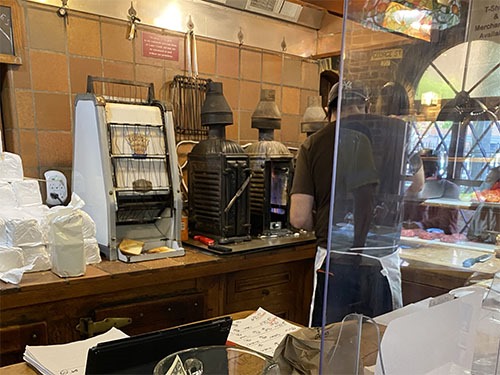
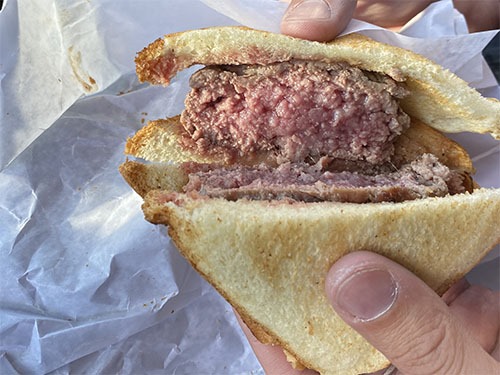
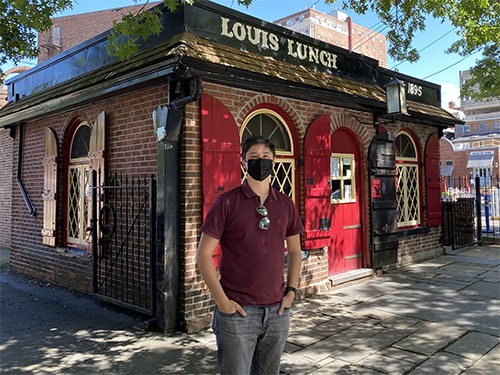
We had three burgers planned today, all big ones that we were excited about. The first was Louis’ Lunch in New Haven, in the shadow of Yale University. Louis’ has been in business since 1895 and is the birthplace of the hamburger sandwich. They ground the meat themselves fresh daily from five cuts of beef then broil them in a proprietary vertical cast iron cooker they invented. The burgers are then served on white toast. They only offer them plain or with Velveeta, grilled onions, and tomato. They make a big deal about not allowing ketchup. Since we were going to have so many burgers today in a short time span, we split one basic hamburger with no toppings – their original. With only meat and bread, the burger tasted almost like a good steak sandwich. The patty was medium-rare, leaving it quite juicy. It was pretty well seasoned, although I would have liked a little more salt. The toast was a little thin for the thick patty, but since it’s sourdough the toast stood up flavor-wise. I wish we had tried one with cheese, onions, and tomato, but this one was really good. It’s not hard to see why they’ve survived and thrived for so long.

Andrew outside the Louis’ Lunch building.
Andrew standing outside a very small, old brick building with the sign Louis' Lunch and  red door.


You can see the unique cast iron cookers here. The patties are attached to a vertical tray that is inserted into the cooker where it’s cooked with flame on both sides. The bread is toasted using the machine on the left.
The cooking area behind the bar. Three old looking cast iron cookers are in the middle. A continuous toaster is the to the left. The cook is working in front of the cookers.


Look how thick that patty is! It’s really a simple burger, but tasty. 
Two halves of a cut burger on white toast. The patty is very thick and almost rare in the middle.


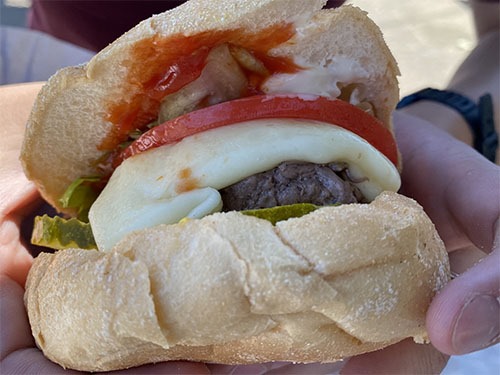
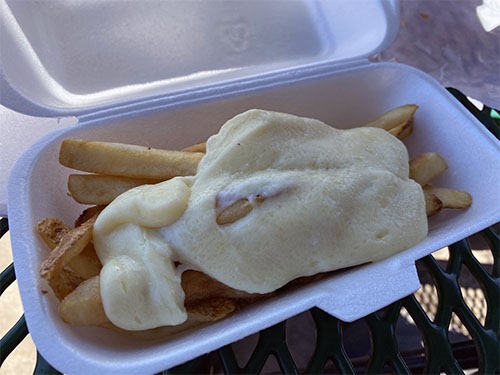
After Louis, we drove about 30 minutes to Ted’s Restaurant in Meridian, Connecticut. Ted’s is famous for their steamed burgers. They steam the meat instead of grilling it. They also steam the cheese. We ordered single cheeseburgers with everything (tomato, onion, lettuce, pickle chips, ketchup, mayo) plus their cheese fries. This was a unique, tasty burger. It was well-proportioned and well-balanced. The steamed Wisconsin cheddar plays a particularly big role in this burger. It adds salt and flavor, but it’s also thick enough to add texture and chew to the burger. The steamed meat tasted good and was more tender than most of the grilled patties. The cheese fries were a bit of a bust; the cheese had cooled into a solid sheet over the fries. We had to tear chunks of cheese off to eat with a fry (which was good). A very enjoyable burger, although I doubt we’ll be steaming burgers at home.

Thick almost puffy burger closeup with a lot of cheese, ketchup, and a slice of tomato. You can barely see the meat under the whitish cheese.


 A styrofoam clamshell box full of fries covered in a thick sheet of cheese


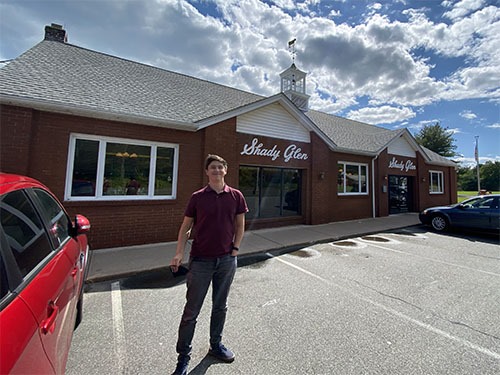
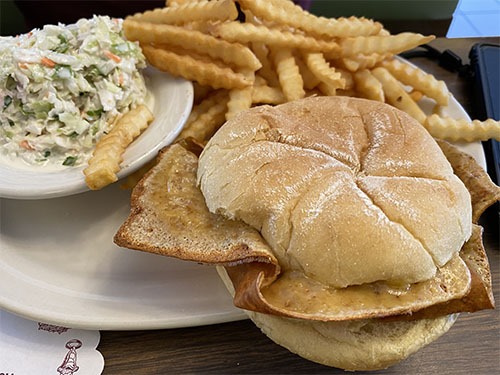
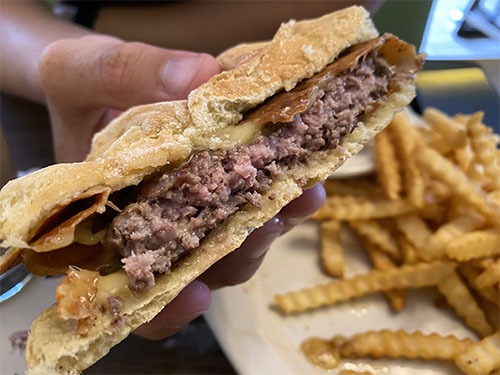
The last burger of our trip was another 30 minute drive away to Manchester, Connecticut at Shady Glen Dairy Stores. Their claim-to-fame is the Bernice Original, a burger with four slices of cheese overhanging the patty onto the grill. The cheese cooks until it’s mostly crisp. Aside from the visual interest, cooking the cheese like that also changes the flavor. When Andrew and took the first bite out of each of our shared burger, our eyes were wide. It was a really delicious bite, and each bite afterwards was equally good. The crisped cheese added a savory and unique flavor as well as some texture. The meat was well-seasoned and cooked well. Just delicious. The coleslaw, which came with the platter, was very good too, kind of KFC-like with a fine dice and a slightly sweet dressing. The fries were fine. Since Shady Glenn started as a dairy, we tried their milkshakes and were not disappointed. Super good. The only real problem was that this was our 3rd burger in 90 minutes, so we didn’t have room to eat more. Although they apparently make this cheese specially for the Bernice Original, I want to try cooking my cheese this at home too. This was probably our second favorite burger on the trip, after the Jucy Lucy at Matt’s Bar in Minneapolis. What a great way to end our burger tasting on this trip! We’ll summarize our burgers and lessons later.
Andrew outside a neat, 1950s looking brick restaurant with "Shady Glenn" written in white cursive over the door.

A platter with a burger, fries, and a small dish of cole slaw. The burger has browned, crispy cheese sticking out.

Image of the burger sliced in half. The meat is medium rare, the bun is prett flattened. There is cheese above and below the patty.

After we staggered out of Shady Glen, we completed our drive and arrived at the Culinary Institute of America. More on that later. We have a day of getting his last few things and exploring the area, then I drop Andrew off tomorrow and head back to Seattle.

Burgertrippers: Day 11 Philly Cheesesteaks

(Read the intro post for background on this trip.)

Today was a tough drive. Andrew (24) and I were on the road for almost nine hours going from Columbus, Ohio to Philadelphia, Pennsylvania. The remnants of Hurricane Ida were beating down on the area, so it rained hard all day. We received tornado watch/warnings and flash flood watches too. We decided not to stop at all, which was a bummer since I had hoped to pay our respects at the Flight 93 National Memorial, especially since it’s just a few days until the 20th anniversary of 9/11.

Today was also a no-burger day for us. Since we are spending the night in Philadelphia, we decided to sample the Philly cheesesteak sandwiches instead. We decided not to brave the bad weather, so we had cheesesteaks delivered from three restaurants to our hotel instead. We chose Pat’s King of Steaks (the original), Geno’s Steaks (across the street from Pat’s and almost as well known), and Jim’s South Street (a favorite among locals). We knew these would be less tasty after waiting to be delivered vs. eating there, but it was a good way to try more of them easily (and stay out of the bad weather.

From each restaurant we ordered cheesesteaks with onions, peppers, mushrooms, and whiz (Cheese Whiz – a classic choice). We also got one sandwich with provolone instead of whiz from Pat’s.

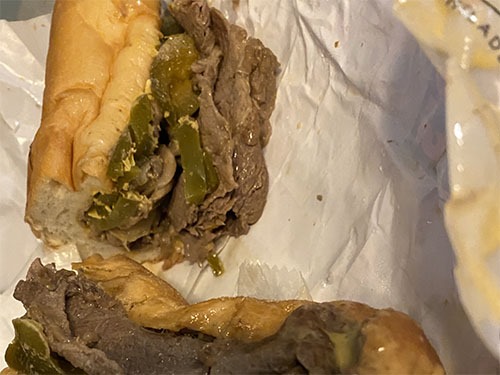
We were pretty surprised how different the three sandwiches were, especially since they apparently all get their bread from the same supplier. Pat’s was pretty disappointing. The meat was flavorless and dry, and there wasn’t much of anything in the bun – less meat, toppings, and cheese than the other restaurants. The bun was stale to boot. We couldn’t tell too much difference between the whiz and provolone versions since there was so little cheese in the sandwiches.We didn’t even finish these.

Whiz and provolone sandwiches from Pat’s. Notice how sparsely filled these are and how dry the buns are.
two thin cheese steak sandwich halves


The sandwich from Geno’s was much better. It had more cheese and toppings, and the meat had more flavor. The bun was damp with cheese and the juices from the meat, which was delicious. This was Andrew’s favorite.

Geno’s sandwiches. Notice how much more filled the sandwich is and how much more the buns have soaked up cheese and juice vs. Pat’s.
Two halves of a cheesesteak sandwich, more filled than than the one from Pat's. The bun is squished a bit.

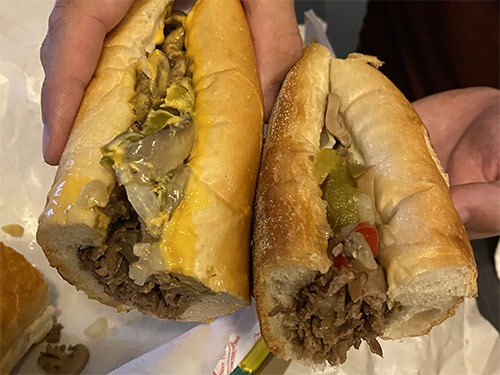
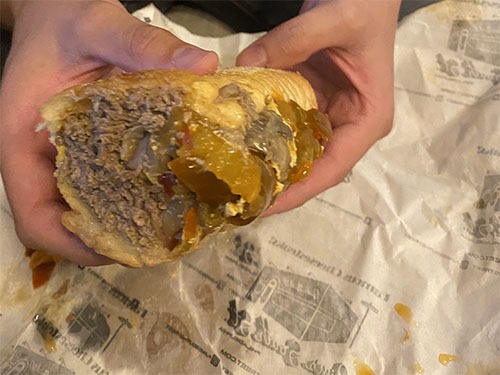
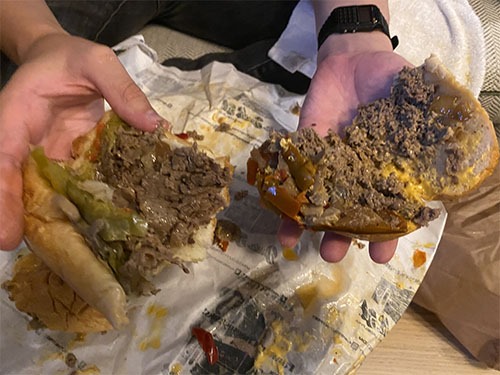
The sandwich from Jim’s had much more meat than either of the others. The meat was also much more finely chopped vs. the others, which were more sliced. I thought their toppings were better than the other two places too, although Andrew wanted more cheese on Jim’s. I thought this was the tastiest sandwich and was my favorite.

Look how much more meat there is in the sandwich from Jim’s. The bun is also soaked with flavor…
Cross section of a really filled cheesesteak sandwich. The bun is completely squished down around the meat.


You can see how much more chopped up the meat is on the sandwich from Jim’s (right) vs. Pat’s (left).
Two cheesesteak sandwich halves, open. The one of the left has slices of beef. The one on the right has almost chopped beef.

It turns out the topic of who has the best cheesesteak in Philadelphia is something of a hot topic, bordering on religion. Pat’s and Geno’s are the best known and have the most tourist attention. There are a lot of other restaurants that also have cheesesteaks here (like Jim’s). I didn’t realize there was so much variation. We’ll have to come back and try more. Hopefully, there won’t be a hurricane, tornadoes, and flooding next time.

Burgertrippers: Day 10 Three burgers from Chicago to Columbus

(Read the intro post for background on this trip.)

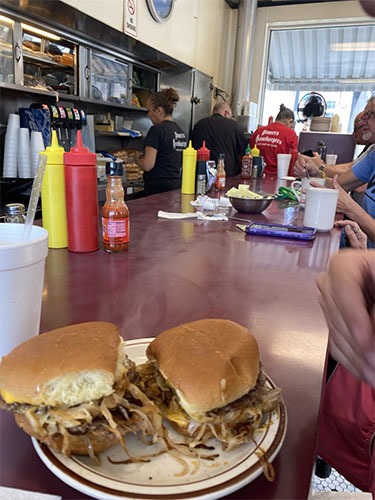
Today was our first three burger day as we drove from Chicago to Columbus, Ohio. The first was at Powers Hamburgers in Fort Wayne, Indiana. The first Powers was opened in 1935; we went to the only surviving location, opened in 1940. This is a little shop with counter seating. As soon as you walk into the restaurant, you’re hit with the smell of grilled onions. The burgers are small, just bigger than a slider but smaller than a McDonald’s cheeseburger. The thin smashburger patties are covered in thinly sliced, grilled onions; these sit on a steamed locally made bun. We had doubles with cheese.

Two small burgers with piles of onions coming out from under the bun, sitting on a plate, on a diner counter. The restaurant staff is busy in the background.

These were really good. Well-balanced and tasty; the onions were a major part of the texture but were not overwhelming. The buns were soft. It’s what White Castle should be, frankly. The place was loaded with regulars; the older guy sitting next to me had been coming since he was a kid and clearly had a lot of fond memories when the restaurant used to be a 24 hour operation, coming in on the last stop on the way home after a night out. Enjoyable burger and stop.

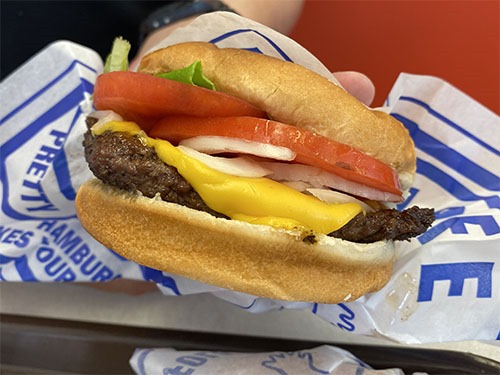
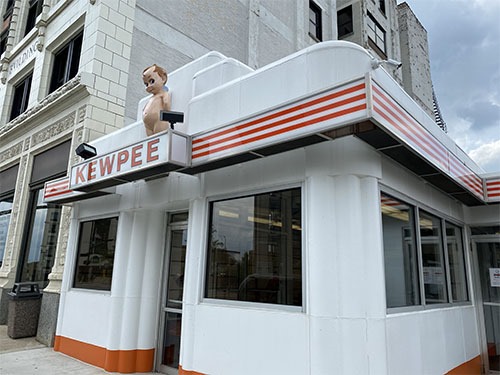
We drove into Ohio and stopped in Lima to visit Kewpee Hamburgers, the second oldest burger chain in the country, after White Castle – founded in 1928. We visited the original downtown location. The burger had a loosely formed patty and topped with American cheese and the standard fixings. We opted out of fries here since we had just had the Powers Burgers not too long ago. This was a really good, solid burger. I thought the bun was especially tasty. We probably should have ordered doubles to improve the meat-to-everything-else ratio. This was probably the closest to an In-And-Out burger that we’ve had on this trip so far.

Close-up of a cheese burger with tomato, lettuce, and onion.

A small white square art deco building with a Kewpee sign and a Kewpee doll over the sign.


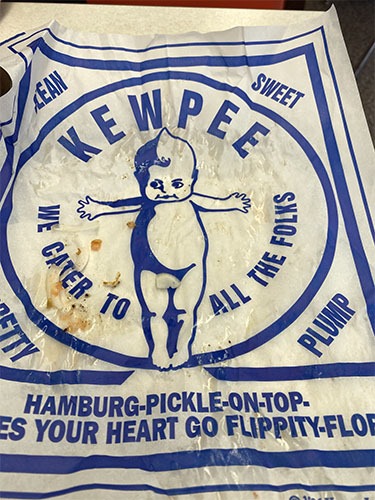
Kewpee burger wrapper with a picture of the doll. The text says "Kewpee - We cater to all  the folks" and "Hamburg-pickle-on-top makes your heart go flippity flop"

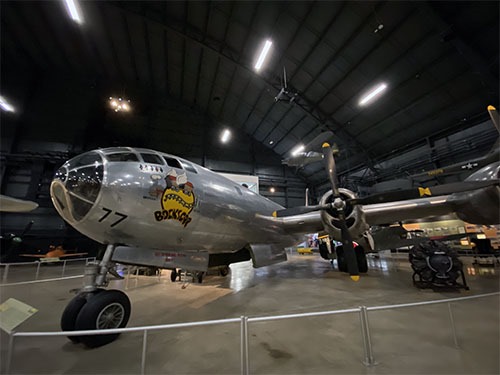
We headed to Dayton, Ohio next to visit the National Museum of the US Air Force. This is the world’s largest military aviation museum. Unfortunately, in my planning I forgot that we’d lose an hour when we crossed into the Eastern time zone; we also got a late start out of Chicago. This meant we only had an hour to see the massive museum. Still, I was excited to see planes I’ve never seen before, like a Twin Mustang and an F-22 Raptor. They also had historically significant aircraft like Bockscar, the B-29 that dropped the second atomic bomb, on Nagasaki Japan. I really want to come back here. The whole area has a lot of flight-related museums and history since the Wright Brothers were from this area.

3/4 shot of the front of B-29 bomber Bockscar.

We finished the day up at Swensens Drive-In in Columbus, OH. This is a regional/Ohio-only drive-in burger chain founded in 1934. They are famous for their Galley Burger – a double cheeseburger with two special sauces. Naturally, we got that, one “with everything” – mustard, dill pickles, and raw onions, and one without. We also ordered their potato puffs – shredded fried potatoes. We wanted to try their potato teezers – potato/cheese/jalopeno combo but they were having supply chain problems and didn’t have them. We tried the substitute – fried mac and cheese balls. We also had their shakes. Frankly, I was disappointed. The burgers were reasonably well constructed and seasoned, but one of the special sauces tasted like a too-sweet barbecue sauce that overwhelmed everything. It was fine but not special. The potato puffs were just tater tots; I felt deceived. The mac and cheese balls were good but not special as were the shakes. Maybe we were just burgered out after our third round for the day, but we were unexcited about this dinner.

Close-up of a double cheese burger


Burgertrippers: Day 9 Iowa and Chicago

(Read the intro post for background on this trip.)

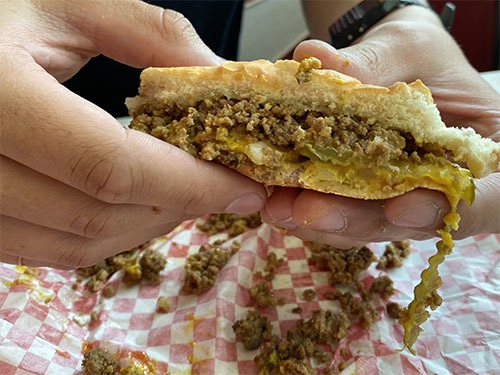
After our detour to Riverside, Iowa to see the Future Birthplace of Captain James T. Kirk, we stopped in Davenport, Iowa to visit a Maid-Rite restaurant. They are known for their loose meat sandwich. This is basically a burger where the beef is seasoned and cooked loose like taco meat rather than being formed into a patty. The chain has been around since 1926. Aside from the loose meat, the sandwich is set up like a burger with the same condiments, bun, etc. We had one with cheese and one without. It tasted a like a decent burger. The meat was well-seasoned and the bun-to-meat ratio was fine. The one with cheese was better since the cheese added some creaminess and mouthfeel that the other one lacked; the loose meat was all cooked to well-done. Not surprisingly, the sandwich was kind of a mess to eat too. We’re glad we tried this, but it’s not something I’d drive a long way for again.

Close-up of a messy burger with browned ground meat falling out.

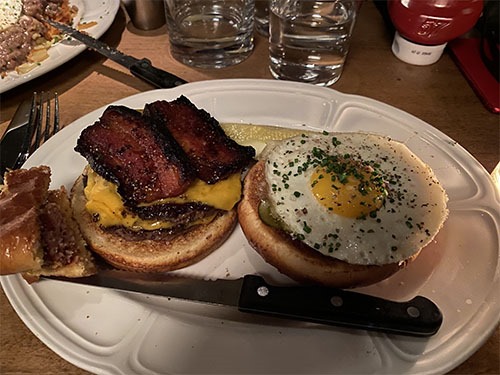
We then drove on to Chicago and went to Au Cheval with my cousin Eric, his wife Melody, her sister Alexa, and Yuri, a friend of Eric’s who was staying with them. Au Cheval has regularly been named the best burger in America, so it was a must-visit on our trip. We had their single cheeseburgers (which are really doubles), one plain and one with bacon and egg. They were gorgeous – really lovely to look at (and post on Instagram). Easily the best looking burgers we’ve had on the trip so far.

Open burger on a plate with two thick strips of bacon topping one side and a fried egg topping the other side.

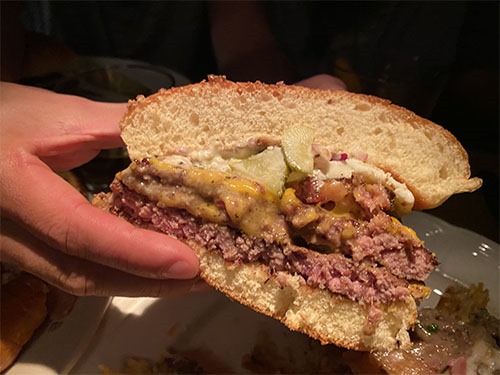
Cross section of a double cheeseburger

These were smashburgers on a toasted brioche bun. The meat was well-seasoned and well cooked, still tender. It was very good, but honestly, I’m not sure how it could have lived up to the “best burger in the country” hype.  Andrew is convinced that brioche is the wrong type of bread for a burger since it disappears into nothingness; I’m starting to agree with him. The bite wasn’t as unctuous as the Jucy Lucy we had in Minneapolis; it wasn’t even as straight-forward tasty as the Double Tavern Burger at Loretta’s Northwesterner in Seattle. Andrew didn’t even finish his burger.

By contrast, he wanted to order another Jucy Lucy after he ate the first one (he would have but it takes a while to get one and we were with friends) and at Loretta’s we actually did get another burger. I really enjoyed it, but I actually liked some of their other menu items better. The foie gras with scrambled eggs and toast was decadent. The omelette was prepared perfectly – light, fluffy, and savory. And the fried bologna sandwich was like bologna sandwiches from my childhood memories kicked up 10000%.

The evening was super enjoyable. Good food and good drinks with family made for a super night.

Burgertrippers: Days 7-8 The Twin Cities

(Read the intro post for background on this trip.)

Andrew (24) and I arrived in Minneapolis/St. Paul, Minnesota (aka “The Twin Cities”) yesterday. We’re spending two nights here as a bit of a rest plus it’s where I grew up, so I thought I’d torture Andrew taking him to all the random places I spent time as a kid. It’s also the first real burger destination on our trip.

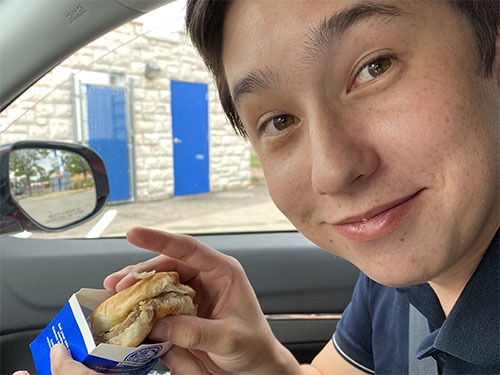
Our first stop was White Castle, the oldest fast food burger chain in the country, founded in 1921. This is a mostly Midwestern chain, so Andrew has never had one (we have stood outside the one in Las Vegas, but opted not to try it then because of the huge line of drunken gamblers). I had built them up to mythical status in my mind. White Castle burgers are unique; they are a small/slider-sized burgers with a super thin, square patty, topped with grilled onions and cheese optionally. The patty is steamed on top of a bed of onions; it has holes so they don’t have to flip the patty over. Each burger is served in a little cardboard holder. This was a disappointment to me; it was not nearly as good as I remembered – bland, too much bun (a little salt or ketchup would have helped though). Andrew actually liked it and came to the same realization that many, many others have: that a bag of these would be good after a night of drinking. The fries were ok, nothing special.

The White Castle burger
Andrew sitting in a car holding a little burger and its cardboard box.

We then went back to Woodbury, my home town, and saw my old house, elementary school, junior high, high school, each of my old friends’ houses, my places of employment, the hospital I volunteered in, and the shops I used to go to. Of course, each location included extensive stories and historical context. He was polite and did a good job pretending to listen/care.

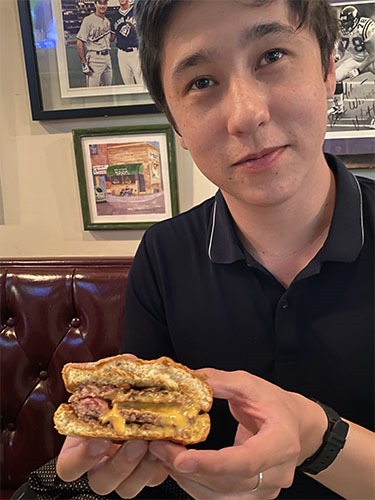
For dinner, we went to Casper & Runyon’s Nook, a neighborhood burger and beer restaurant open in since 1938. I tried their Juicy Nookie burger (their take on a Jucy Lucy – see below for more on that), and Andrew had their Triple B (Bourbon Bacon Burger). The Juicy Nookie had the cheese in the meat. The waiter and the menu warn patrons to let the burger cool a bit since the molten cheese will squirt out otherwise. This was a thick patty (really a double) with grilled onions on a toasted bun. It was very tasty – well grilled, well seasoned. Andrew’s Triple B was pretty good, but the bourbon barbecue sauce was too sweet. He didn’t actually finish his burger. We also had walleye fingers (deep fried nuggets of walleye pike: a local freshwater fish and one of my very favorite fish to eat) and “Nook Curds” – honey glazed deep fried cheese curds with bacon – decadent and delicious. The fries were once-fried cut potatoes – very good (but I [refer crunchier fries).

The Juicy Nookie
Andrew sitting in a restaurant booth, holding a burger cut in half to show a patty with a pocket inside and melted cheese oozing out.

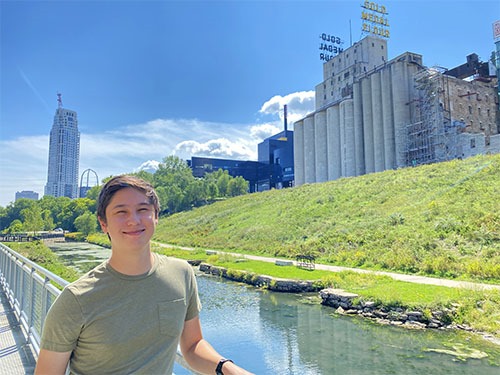
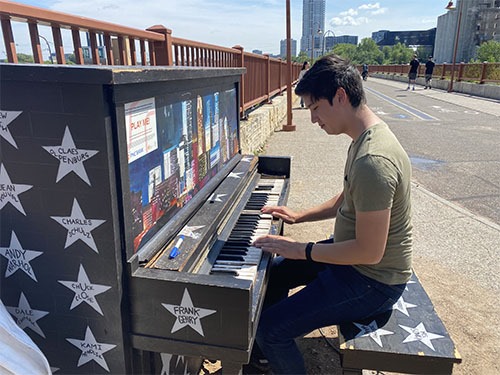
On Day 8, we needed a break from eggs and burgers, so we had dim sum at Mandarin Kitchen. It was very, very good – nice variety of dishes with good quality. It was better than most in Seattle. We then walked around the Mill District in Minneapolis. This is an area around St. Anthony Falls on the Mississippi River (the only major waterfall on the Mississippi) that used to have something like thirty flour mills and was the largest producer of flour in the world. It’s now been revitalized with museums, riverside parks, the Guthrie Theater, and walk ways. Andrew found a public piano (pretty broken actually) and gave an impromptu concert. I really like this area.The only bummer (to me at least) is that the Mill City Museum is still closed due to COVID. Fortunately, there are a lot of signs on the walkways nearby, so I learned a fair bit about the history of the area anyway. Andrew was politely patient, although he began mocking me a bit by pointing out signs I missed. I had originally planned to go to the Minnesota State Fair, which I loved as a kid, with special food memories – Pronto Pup corndogs (which I just learned are actually from Oregon), mini donuts, and the best strawberry ice cream ever at the Dairy Building. But, the prospect of being in a huge crowd of mostly maskless people on top of our existing travel risks wasn’t appealing. Oh well.

Andrew in the Mill District, in front of the old Gold Medal Flour mill
Andrew standing on a walkway in front of an old canal with a set of tall concrete grain silos behind him. A big sign saying "Gold Medal Flour" is on top of the silos

Andrew playing an upright piano painted with white stars and a mural. The piano is outside by a railing on the sidewalk.

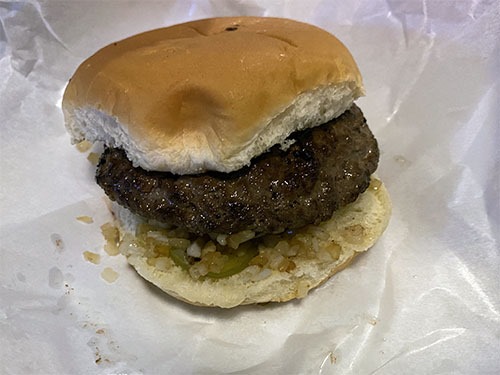
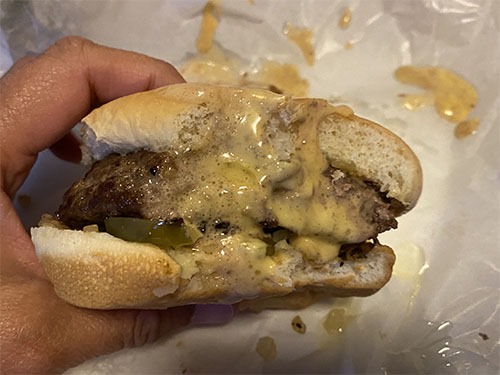
The main attraction of this stay in the Twin Cities was the Jucy Lucy burger at Matt’s Bar. This burger is famous enough to have its own Wikipedia entry and has been in the media a lot. President Obama even stopped by and had one. The Jucy Lucy has the cheese stuffed into the burger patty; the cheese is basically stuffed between two single patties. The edges of the patties are sealed to keep the cheese inside. The burger is simple otherwise, with just pickle chips and finely chopped and grilled onions on an untoasted bun. No sauces or condiments. It was perfect. Maybe the best burger of my life. The meat was good quality, well-seasoned, and well cooked. The cheese mixed with the burger juices and kept the burger moist. The finely cut grilled onion were a great complement; they didn’t overwhelm a bite like the bigger slices at the Nook. The bun-to-meat ratio was spot on. Every bite was absolutely delicious. An order of fries is huge, even for two people. They were pretty standard restaurant fries, but of course we ate them all. This dinner was especially special because we enjoyed with with my high school friend Stephanie and her son Soren. Good food is always better with good friends.

The Jucy Lucy – pretty straightforward and not fancied up for Instagram. Note the finely chopped onions.
A thick hamburger on a paper wrapper. The patty sits on finely diced grilled onions and a pickle chip.


The cheese and juices started oozing out after my first cautious nibbles.
jucylucy2


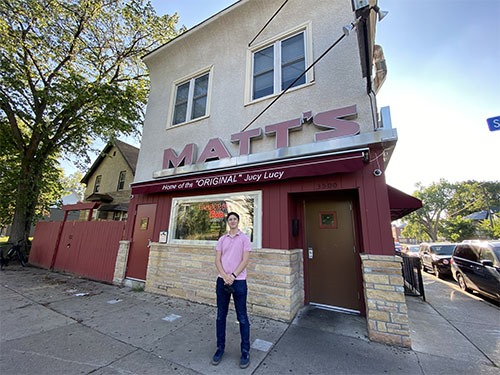
Matt’s is an unassuming neighborhood joint. The prices are still super reasonable ($8.75 for the Jucy Lucy) despite their fame.
matts


Burgertrippers: Day 6 Driving across South Dakota

(Read the intro post for background on this trip)

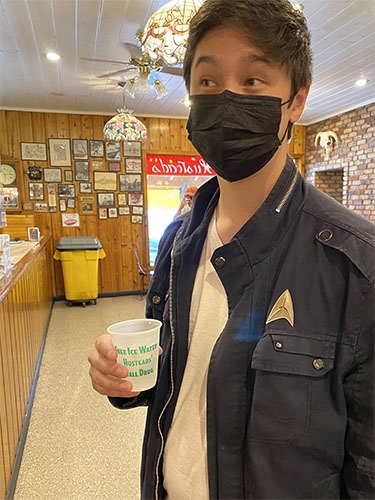
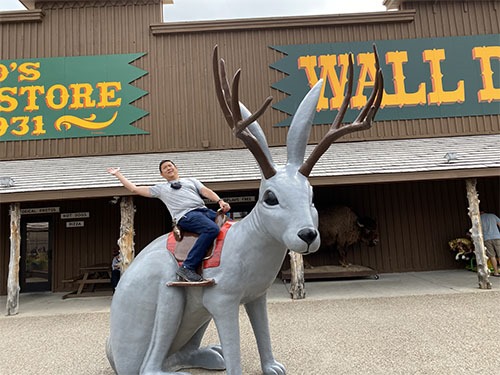
Andrew (24) and I kicked off our day at Wall Drug, the classic South Dakotan tourist trap destination. They were a little drugstore in the 1930s who started to advertise free ice water to drivers going to Mount Rushmore; the business took off from there. It’s even bigger and kitschier than I remember; this was Andrew’s first time. He enjoyed it though, and I got my free glass of ice water and “Where the heck is Wall Drug” bumper sticker. I also rode the fearsome jackelope

Andrew with free water
Andrew hodling a plastic cup of water that says "Free water Husteads' Wall Drug"

Me taming the jackelope
Tony riding a 10'+ tall jackelope model at Wall Drug


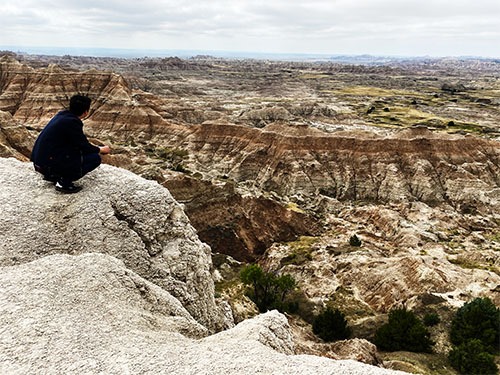
After we drank our fill of free ice water, we went to Badlands National Park (not the best naming…) This is a dramatic landscape of grasslands cut with deep, colored ravines and pinnacles. Andrew had never heard of the park but was super impressed.

Andrew surveying the Badlands
Andrew crouched on a ledge overlooking a rocky valley


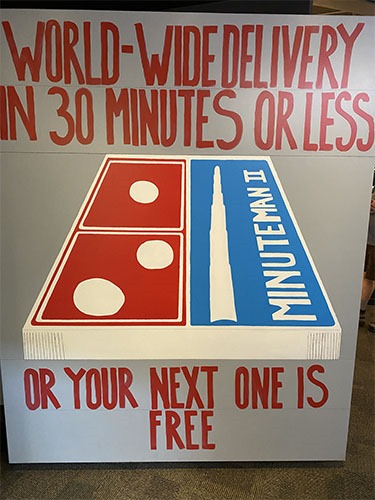
Just as we came out of the Badlands, we stopped at the Minuteman Missile National Historic Site.  This national site is located on what used to be a nuclear missile base housing ten Minuteman ICBM silos (since deactivated as part of the START II arms control treaty.) The little museum and theatre is solid. You can visit an old control room and a silo (both a few miles away), but apparently unless you make an appointment, there’s nothing really to see from the outside. We didn’t go see those.


Mural from the Minuteman control room
Mural saying "World-wide delivery in 30 minutes or less or your next one is free" and a Domino's pizza box with a Minuteman II label and image on it.


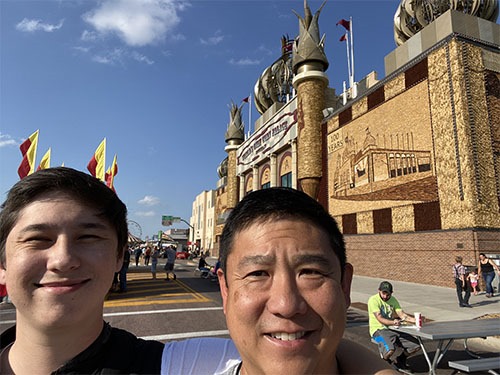
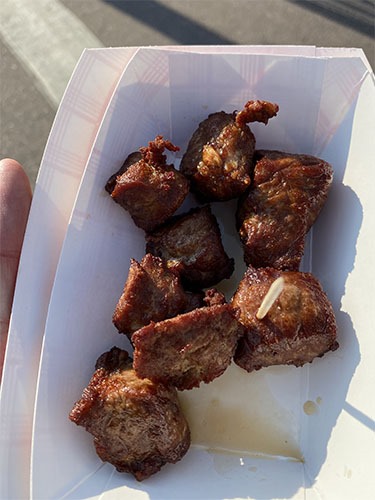
The next stop was the Corn Palace in Mitchell, South Dakota. I have strong memories of seeing the Corn Palace as a kid, so I figured it was worth a few minutes to swing by and see it again. They change the murals made of different colored corn each year, so it looked different (but kind of the same) than before. There was a fair on the streets around the Corn Palace, with games and food vendors. I took the opportunity to try chislic. This is dish of deep-fried cubes of red meat, classically mutton but often beef or game meats, eaten with a toothpick and served with saltine crackers. It’s a South Dakotan delicacy, even being declared the state’s “official nosh”. Deep-fried meat sounded right up my alley, but the version I had was only OK.

Andrew and me in front of the Corn Palace
Selfie of Andrew and Tony in front of a palace-like building covered in murals made from corn.


My first taste of (beef) chislic
Paper dish of fried meat cubes and a toothpick


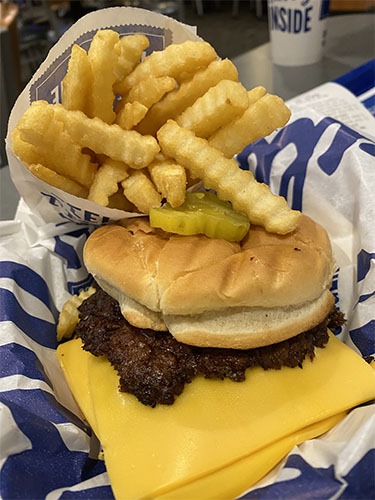
We finally got to Sioux Falls for the night. I don’t recall having spent any time in Sioux Falls before (I think my dad just drove past every time.) The falls area is very nice as is the revitalized downtown area. We also had our first regional burger chain of the trip – Culver’s. This is a mostly Midwestern chain (although they’re in 25 states now) famous for their Butterburger and custard ice cream. We figured anything named “Butterburger” must be good, so we gave it a try. The Butterburger is so named because they butter and toast the buns. It’s a smash burger using never-frozen beef. The patties are pretty thin, so the double was much better than the single, which was overwhelmed by the condiments (which you specify – we had ketchup, mustard, and mayo). The outside the patties was pleasantly crunchy and well-cooked, and the buttered and toasted bun was good. The cheese was not melted however. The crinkle fries were fine but nothing special. I liked the custard ice cream (especially the chocolate, which tasted like the old Frosty Malts at baseball games – definitely a nostalgic memory for me.) Their house-brand root beer was bland and boring. Overall, it was a great fast-food burger. I’d take it over any of the big burger chains, but In-and-Out beats Culver’s in my mind (although I’d like to try them side-by-side some day.)

Culvers Double Cheese Butter Burger and fries. Note the crispy patty edges and unmelted cheese.
Double burger with unmelted American cheese. Crinkle fries behind it.


Burgertrippers: Day 5 Devils Tower, Crazy Horse, and Mount Rushmore

(Read the intro post for background on this trip)

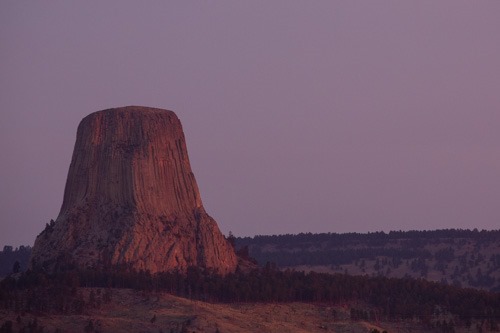
After a semi-rough night of sleep in the tipi due to the high winds, we got up at 5:45am to watch the sunrise and get to Devils Tower before the crowds.

Tall rock tower at sunrise with a purple sky

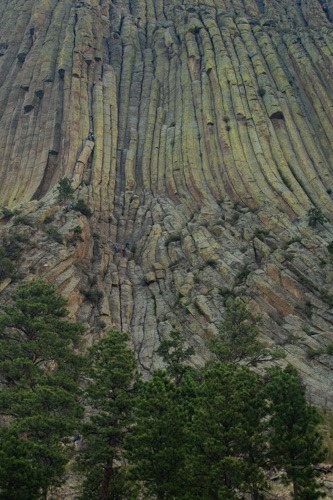
We got to the park and then did the 1.3 mile hike around the base. It was cool to see the tower up close and see how it different it was on each side. Up close, it’s really apparent that the tower is made up to columns of rock, some of which have calved away from the tower forming the rubble piles surrounding the tower, but apparently none has fallen in recorded history. Even though we were there early (before even the visitor center had opened), there were already climbers on the tower. The first climbers to summit the tower were two local farmers who did it in the 1890s as a publicity stunt, using a stake ladder. Wild.

Closeup view showing the columns of rock of Devils Tower. It looks like a tree trunk.

After our early morning hike, we semi-randomly picked a place for breakfast in Sundance, Wyoming. This is the town which gave the Sundance Kid his name but is not where the movie festival is. The Bearlodge Bakery turned out to be a really excellent restaurant; we both had an amazing breakfast burrito covered in green chile sauce. Sadly, today was their last breakfast service. The owner was closing the restaurant and trying to find a buyer. She can’t get enough long-term employees to sustain the business. Really sad.

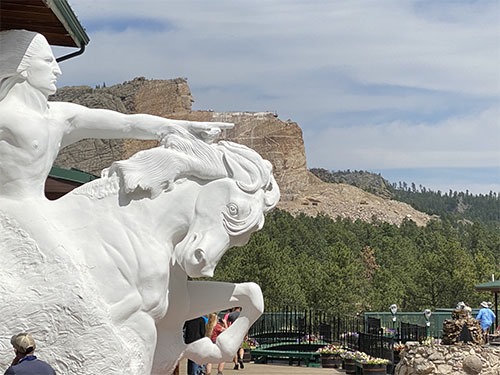
We then headed up to see the Crazy Horse Memorial and Mount Rushmore – two massive sculptures cut into the mountains. The Crazy Horse sculpture is still a work in progress. The last time I saw it (probably in the early 1980s) it was still being roughed out, with just a flat spot for the top of the arm and a hole under it. Now the face is complete and more of the sculpture is roughed out. You can see from this picture what the final sculpture is planned to look like and where the mountain is today.

Completed scale model of Chief Crazy Horse on his horse in front of the partially completed sculpture on the mountain

The project was started in 1949 but hasn’t taken any money from the US government. It’s progressing very slowly. I have to admire their tenacity though.

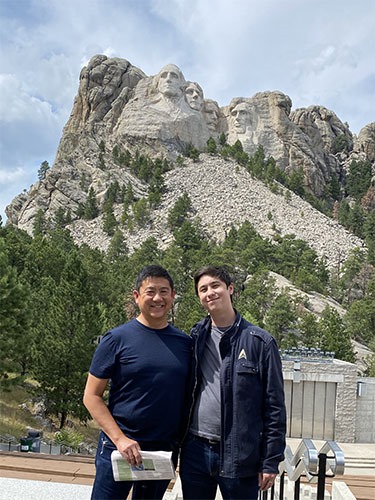
Nearby, the Mount Rushmore facility has improved a lot since I saw it last in 1990, with much more parking and a bigger/nicer visitor center. The museum provided more information how they actually did the work and how the artist had to keep redesigning the sculpture as he found weak rock (including having to destroy much of the original Thomas Jefferson sculpture). I also learned the government’s funding priorities due to World War II and the death of the artist resulted in not completing the original plan of showing the Presidents’ torsos. Regardless of what I might think about carving up mountains, I am impressed by the scale, audacity, and invention it took to create these.

Tony and Andrew standing in front of Mount Rushmore

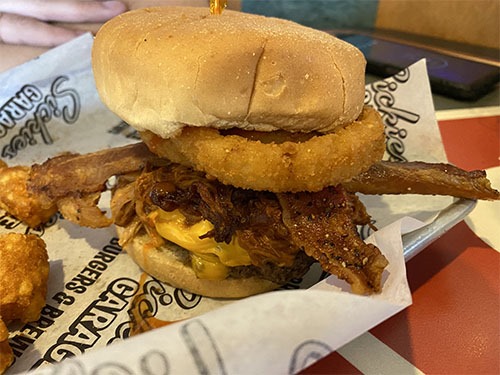
We spent the night in Rapid City, South Dakota. Since we didn’t have any planned burgers in Rapid City, a little internet sleuthing resulted in us going to Sickies Garage Burgers & Brews for dinner. The server mentioned they are famous for having a lot of different kinds of burgers, which they certainly do. Andrew had their eponymous Sickies Burger – a 1/3 pound burger with peppered bacon, fried egg, pulled pork, BBQ sauce, American cheese, an onion ring, and Frank’s Hot Sauce. I had a classic cheeseburger but made with an American Kobe beef patty. Both were excellent – good ingredients prepared with good execution. The meat tasted good, with a nice sear. The fries and tater tots we had were the standard frozen stuff, but they were fine. Sickies offers different seasonings for them like Cajun spice, so that’s nice. Super solid meal.

Andrew’s Sickie Burger
A cheeseburger with an onion ring on top, bacon poking out, pulled pork and cheese inside, on a lined baking tray with tater tots.

Burgertrippers: Day 4 Cody to Devils Tower

(Read the intro post for background on this trip)

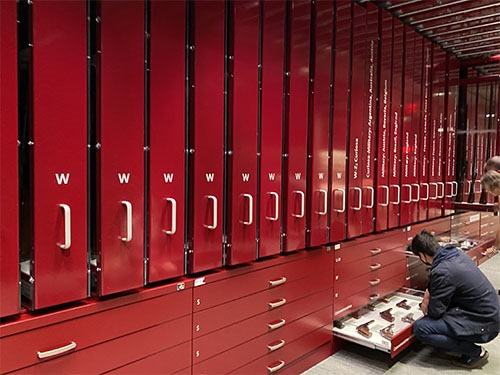
After a really good breakfast at our now-beloved Shoshone Lodge, Andrew (24) and I headed into Cody, Wyoming to visit the Buffalo Bill Center of the West museum. This complex is really five museums in one – the Buffalo Bill Museum, Plains Indian Museum, Cody Firearms Museum, Draper Natural History Museum, and Whitney Western Art Museum. We went through the Buffalo Bill, Plains Indian, and Cody Firearms museums. All of them were excellent – well curated with outstanding artifacts. I thought they handled potentially sensitive topics in a balanced ways. I didn’t know much about Buffalo Bill Cody going in, so it was super interesting and educational; he reinvented himself so many times and was pretty remarkable. The Cody Firearms museum was particularly impressive. It’s the largest publicly viewable firearms collection in the world. They have so many out that they have put many of them in drawers that visitors can pull out. I wish we had time to linger in the museums we visited and to see the others. I’d definitely come back if I’m in the area.

Rows of red vertical and horizontal pull out drawers loaded with firearms. Andrew is kneeling looking a pulled out drawer of handguns.


We then visited the Heart Mountain Interpretive Center, which is about 15 minutes from Cody. This museum is on the site of the Heart Mountain “relocation center” where 14000 Japanese-Americans were incarcerated during World War II without due process. Half were under the age of 18 and two-thirds were American citizens. It became the third largest city in Wyoming and had a bigger population that Cody does today.

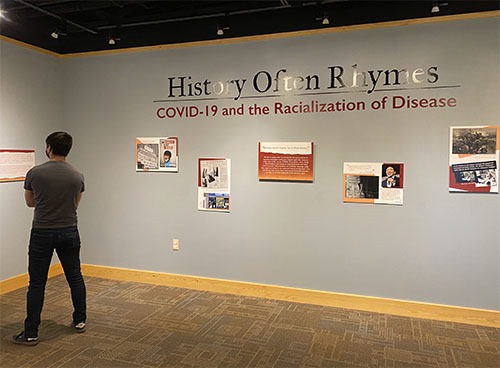
This is a subject I know a little about, especially since the first Japanese-Americans were shipped off to the camps from a dock about a mile from my house on Bainbridge Island, Washington. I still learned a lot; I was especially interested in the post-war phase, which most of the other accounts I’ve read don’t cover. There was a shortage of housing post-war for everyone, but it was especially tough for the Japanese-Americans coming back. They had lost everything, had little or no money, and often returned to racism and hostility. Even though almost all of the building from the camp are now gone, standing on the site was pretty emotional for me and brought the immense scale of the camp to life. The museum had a very timely special exhibit about how disease has been racialized throughout American history up to and including the current COVID pandemic. The whole museum made it super clear to me how easy it is for Americans to turn on each other during times of fear and hatred.

Andrew reading a museum exhibit wall with the title 'History Often Rhymes" and the subtitle "COVID-19 and the Racialization of Disease"


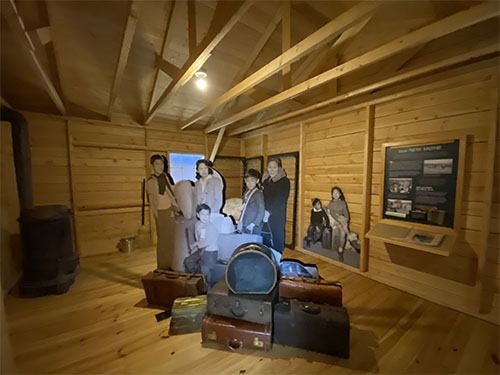
An exhibit showing how bare the incarceration camp barracks were when the Japanese-Americans first arrived.
A pile of luggage and lifesize photo cutouts of a Japanese American family in the middle of an empty, bare wood barracks.


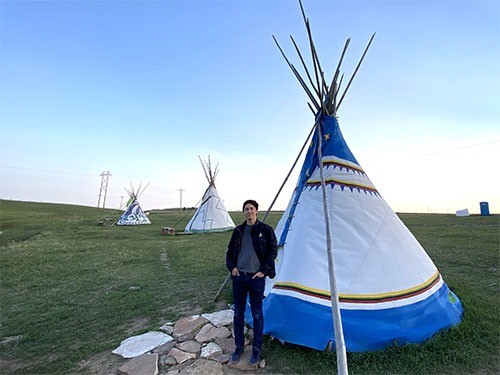
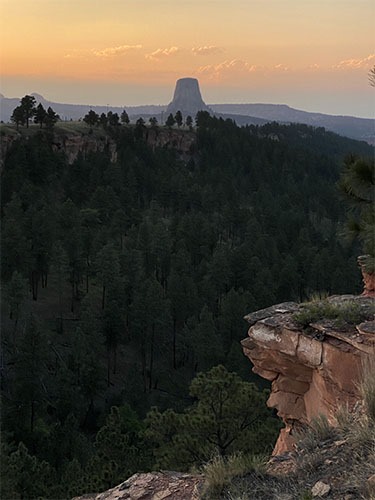
We then drove across Wyoming to reach our accommodations for the evening near Devils Tower, an AirBnB called Devils Tower Tipi Camping or Sunshine Crappy Fish. This was a super unique night for us, sleeping in a tipi with no running water or power. The camp is a few miles from Devils Tower with a clear view of the tower. One of the other guests gave us a great tip to walk over to a bluff nearby on the property to get a really incredible view of the tower, overlooking a ravine. That night we were also able to really see the stars and the Milky Way since there was so much less light pollution out here than most places we travel. We were also treated to a far-off lightning storm and thunder, which was pretty cool.

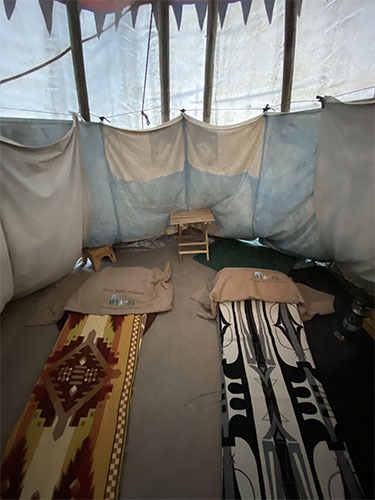
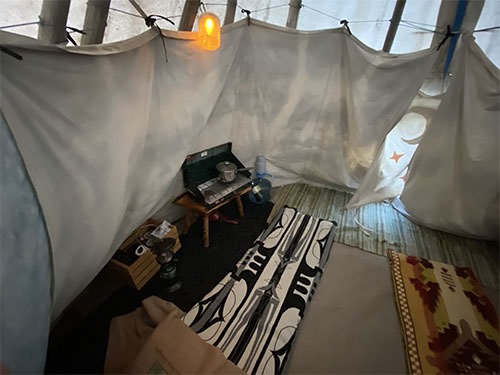
The tipi itself was warm and cozy. We slept on pads on the ground with blankets. The tipi came equipped with a propane stove, propane lamp, three gallons of water, mugs and instant coffee, and two solar lanterns. The only restroom on the site is a super clean Porta-Potty.The only real bummer was that it was a very windy night (20 MPH+), so the tipi fabric was noisy like any tent would be.

There are no dining options on-site and we arrived too late to really go to the any of the restaurants nearby. We were prepared and had brought a picnic lunch with us. No burgers for us tonight.

It was a fun place to stay and a great jumping off point to visit Devils Tower in the morning.

Andrew standing by our tipi
Andrew by tipis


Our sleeping arrangements inside the tipi
tipi inside 1


Our “kitchen” inside the tipi
tipi inside 2


The amazing sunset view of Devils Tower from the property.
Devils Tower view