Ditan Park Wrestling

  • Published Date:
  • by
  • Category:

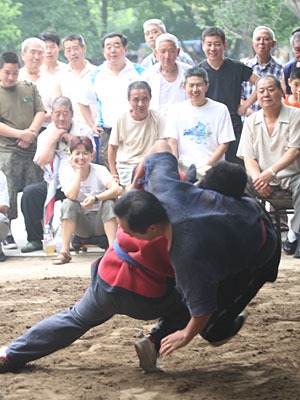
During my visit last Saturday to Ditan Park, one of the coolest martial arts I saw was shuai jiao. This is a type of Chinese wrestling. Based on my observations, a wrestler scores by making his opponent fall; no need to pin.

There was a wrestling ring raked into the dirt. On one side of the arena there was a table set up with the guys who were clearly the elders of the Ditan Park shuai jiao scene.
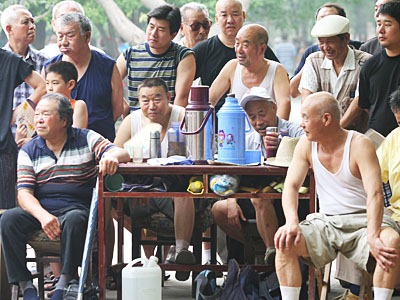
Table with tea thermoses on top, surrounded by older men. 

They kept laughing, yelling advice, and shaking their heads during the matches. This guy in particular was clearly the head dude. After many of the falls, he would jump into the ring and show one of the wrestlers how to fix some mistake he had just made.
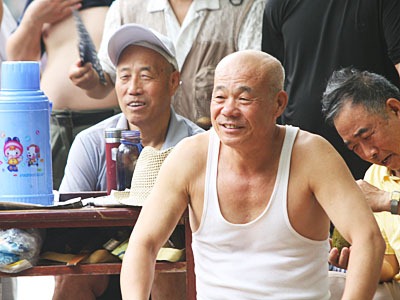
Old, smiling man in a white tank top t-shirt watching the match. 

There were a few rounds, starting with the beginners. By the mid round the wrestlers had a little more swagger and were clearly better, moving faster and having better technique.
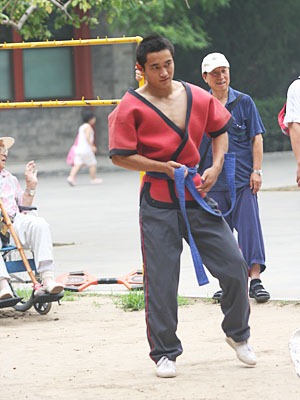
Young wrestler in a red shirt adjusting his belt. Wrestler in red throwing a wrestler in blue.

The highlight, though, came when the local champ (in red below) arrived. (The whole match seemed to be waiting for him to show up.) His opponent was no slouch, having been Beijing's representative in the national shuai jiao competition.
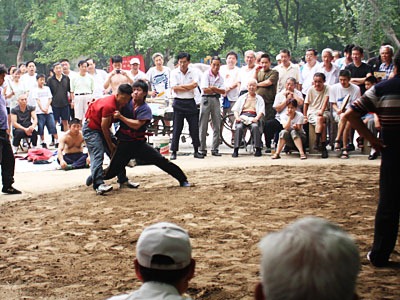
Wide angle shot of two wrestlers wrestling as the crowd watches.

Of course, this being China, the champ interrupted the match to receive a cellphone call.
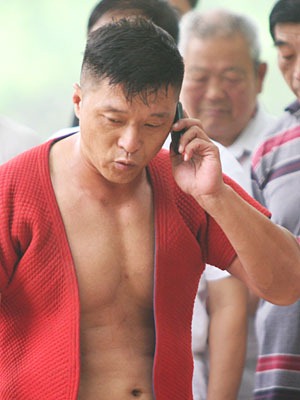
Zoomed in shot of a muscled wrestler in red talking on his cellphone. 

After his call, he put down his phone and proceed to kick the other dude's butt. He launched himself at the smaller guy and just flattened him.
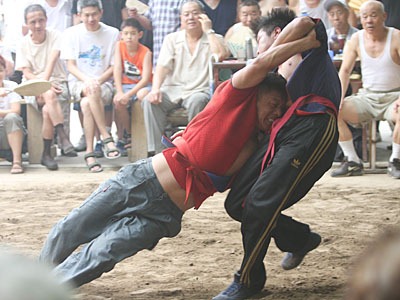
Wrestler in red pulling down a wrestler in blue.

It was a very friendly atmosphere with lots of smiling and laughing between the contestants and coaches. They clearly were having fun and respected one another. There didn't seem to be any of the real hostility than can come with fighting sports. The large crowd seemed to enjoy it too. I did.
More on shuai jiao from Wikipedia.

Martial Arts Diversity

  • Published Date:
  • by
  • Category:

During my visit to Ditan Park last Saturday morning, my friend Kevin and I saw Beijingers practicing a wide range of martial arts styles. It was especially great to have Kevin explaining things to me; he's studied taiji (tai chi) for over ten years and was well versed in a lot of the different styles.

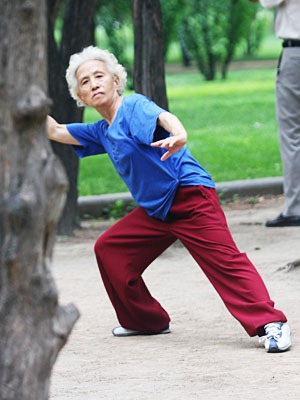
Some people were in the park practicing on their own. I couldn't stop watching this woman. Even though she is clearly older, she was absolutely fantastic. She had deep poses and had rock solid balance. I only wish I had been standing two feet to the right when I took this shot so the tree wasn't in the way.
Older woman doing taiqi.

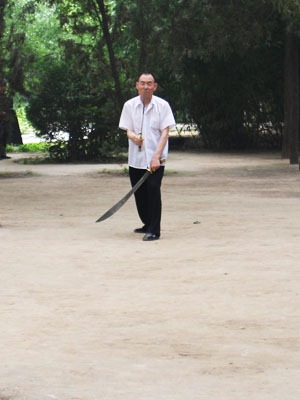
There were people practicing with weapons too, like these spear and sword guys.
Man practicing with a Chinese spear. Man practicing with two Chinese swords.

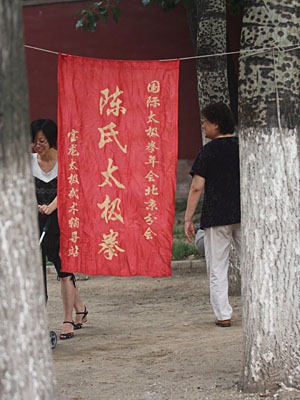
Others practiced with schools. During the week the schools practice in buildings, but during the weekends they come out to the parks. They apparently have their territory staked out. They indicate their school with banners they hang out.
IMG_9666 copy

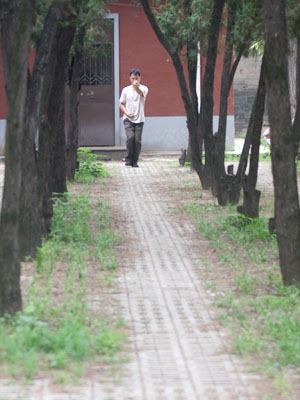
You can really see the difference in some of the forms. This is a northern style that emphasizes straight line attacks. They even practice along straight paths.
Man doing martial arts on a tree lined path.

By contrast this guy is practicing on a ring of bricks. He stepped brick to brick as he practiced his forms.
IMG_9665 copy

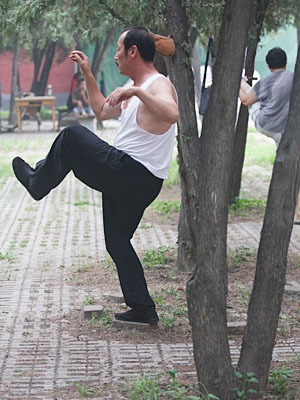
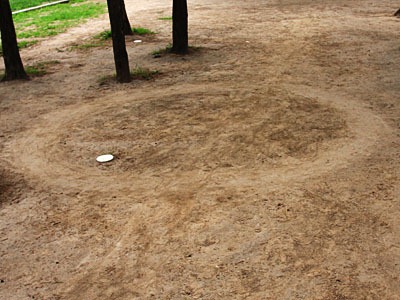
There was a guy practicing bagua over and over again, forming a circle in the dirt. I'm only sorry I didn't get a photo of the dude too.
Circle in the dirt.

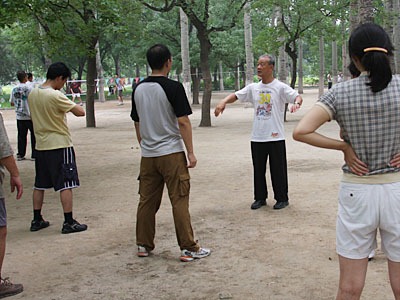
There were some beginners too. This is a well-known taiqi master working with a set of beginners.
Taiqi instructor facing a row of students.

Unlike martial arts classes in the US, there were no fancy uniforms or belts. People were practicing in leather shoes, sneakers, jeans, shorts, whatever. It was really cool to see this all in one place. I'll have to find a class and come out.

A Bustling Saturday Morning at Ditan Park

  • Published Date:
  • by
  • Category:

On weekends, Beijingers flood into local parks to hang out and partake in all manner of activities -- martial arts, dancing, chess, opera, you name it. Last Saturday, my friend and colleague Kevin took me to a big park in the middle of Beijing, Ditan Park, to see the action.

Ditan is especially known for their martial arts, but there's lot more going on. Here are a few of of the non-martial arts activities. I'll post some martial arts photos next.

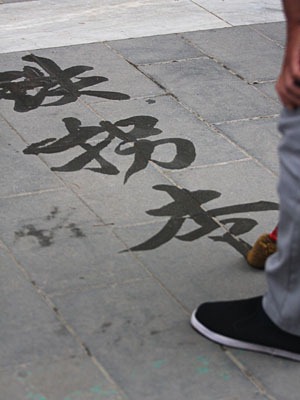
There were a bunch of people practicing Chinese calligraphy with 2.5 foot long brushes dipped in water. They'd use these write on the ground. There's something a little sad about the beautiful calligraphy fading into nothingness as the water dries.
Man practicing Chinese calligraphy on ground.

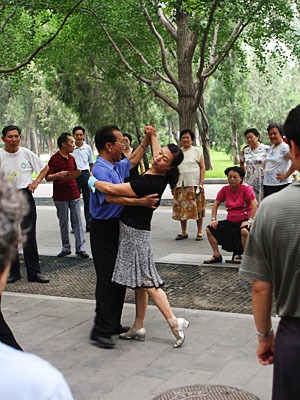
There were a lot of dancers -- from lines of women doing traditional Chinese dances to ballroom dancers like the folks below learning tango. (The couple in the middle were the instructors.)
Tango dance instructors surrounded by students.

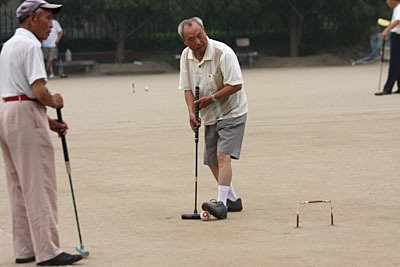
There were folks playing different sports like badminton (which is hardcore in China). These guys were playing menqiu or gateball, a simplified version of croquet.
A man ready to hit his ball with a mallet while another watches.

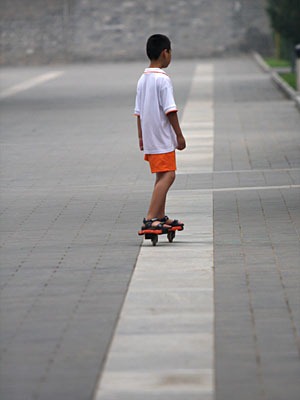
Not everything was old or classically Chinese. There were kids inventing the new China too.
Boy on a jointed skateboard.

[2009-07-18 Added missing photo and alt tags.]

Following Beijing Air Quality

  • Published Date:
  • by
  • Category:

This is so cool. The US Embassy (I think) is Twittering Beijing air quality stats. In addition to the sheer coolness of it, there have been some concerns that official local sources may not always have accurate numbers. Of course, I feel worse now about how bad the air really is. The average yesterday was 201 (very unhealthy) while I was hiking around town.

www.twitter.com/beijingair

Twenty Years Later

  • Published Date:
  • by
  • Category:

Yesterday was the twentieth anniversary of the Tiananmen Square massacre (known as the "June 4 incident" or just "6-4" here in China). I was a junior getting ready for finals at Stanford during the period leading up to that sad day. I remember very well trying to follow what was going on; there was no Internet, just newsgroups, at the time so I spent every spare moment in the computer lab reading the rumors and news bits that were dribbling out of China via fax and other means.

When the news of the shootings came out, I sobbed, uncontrollably for a while. Honestly, this reaction surprised me. It was really the first time I felt any connection to the people in China. Prior to this time, I had always viewed the people in China as different from those of us who supported "Free China" (Taiwan). But, these were college students like me, my peers. They simply wanted what I already had. We were the same. I was Chinese too.

So, fast-forward twenty years: I live in China now. On a day-to-day basis, it doesn't feel like I'm living in the same country that we saw in the news reports twenty years ago. In many ways it's not. But, every so often there's a reminder. When the about-to-open Mandarin Oriental Hotel burned down, there was no news coverage of the event (there's no live news coverage in China) and the incident was downplayed. I actually learned about it via friends' posts on Facebook. Then, this week, the service I work on, Bing (Microsoft's newly re-branded and greatly improved search service) was blocked in China along with Live Spaces, Twitter, and FlickR and some other sites; the government wanted to suppress access to controversial content.

Interestingly and perhaps non-intuitively to many outside of China, this day is not viewed as a particularly memorable or important date to many Chinese, at least the ones I talked with about it. Since it's not discussed or taught here, my guess is that most young people simply don't know much about it.

For older folks, I have some speculation. During the lifetime of everyone alive today and even before, China has suffered greatly from humiliation by foreign powers, Japanese atrocities, civil war, the Cultural Revolution, famine, poverty, and so on. First, while terrible, the events in Tiananmen and Beijing twenty years ago may not be any more significant than dozens or even hundreds of other incidents in modern Chinese history. These last twenty years have been increasingly stable and prosperous; people are proud of what China has become (culminating in the awesome Olympics last year) and satisfied that they are better off than the generations that preceded them. They're also optimistic about the future. There's simply little reason in their minds to make a big deal about this or to rock the boat.

I struggle with the question of whether we're helping or hurting things by living here. I certainly don't support the lack of freedoms here. (You can see a brief view of my political beliefs in my short-lived 2004 presidential campaign...) But, ultimately, I think constructive engagement is the best way to influence other countries. Still, just writing this article and thinking about that horrible day twenty years ago gives me pause.

Fortune Cookie Billboards

  • Published Date:
  • by
  • Category:

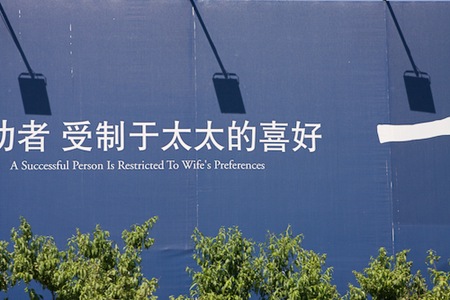
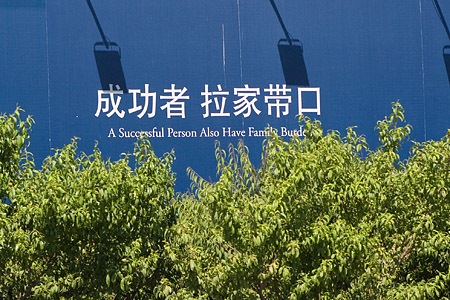
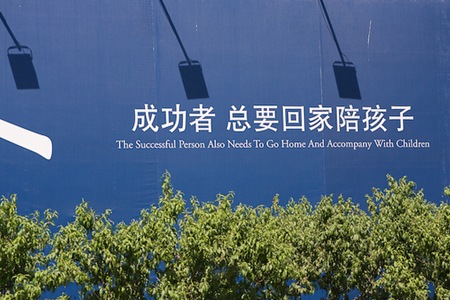
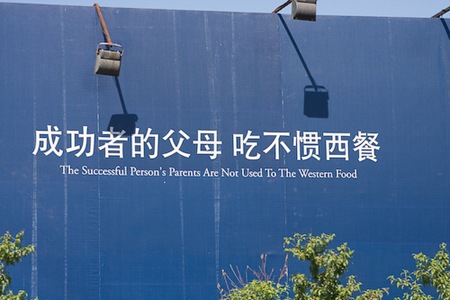
As you probably know, there are no fortune cookies after meals in restaurants in China; those are definitely an American innovation. However, there are lots of enigmatic expressions posted everywhere. Here are a few on big billboards near our house, advertising our villa district (neighborhood).

Note, they're no better in Chinese.

Sign saying "A Successful Person Is Restricted to Wife's Preferences"

Sign saying "A Successful Person Also Have Family Burdens" 

Sign saying "The Successful Person Also Needs To Go Home And Accompany With Children"

Sign saying "The Successful Person's Parents Are Not Used To The Western Food"

Based on these, I'm feeling pretty successful...

One Small Step

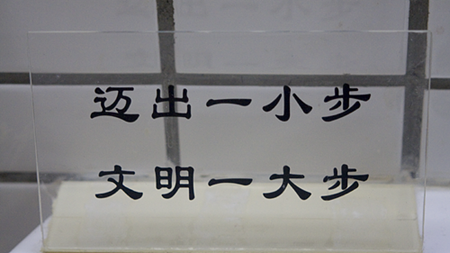
Chinese bathrooms are generally kind of gross, even in nice places. That said, there's definitely been a huge improvement even in the few years since I've been visiting Beijing. Here's a funny sign on top of a urinal that shows the effort to make things better.

onestep

The message is basically something to the effect of:

One small step forward
A big step forward for civilization

(mai chu yi xiao bu, wen min yi da bu)

OK, it was funny to me. More places could use this sign, even in the US.

Object of Desire: Chang Jiang 750 Sidecar

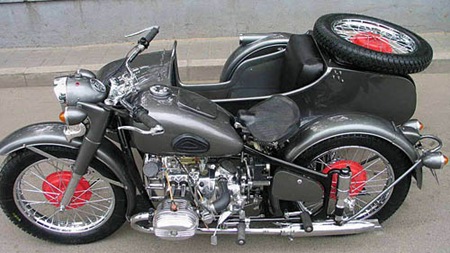
Recently, I've been afflicted by a disease common to many men (esp. expats it seems) in Beijing: I'm obsessed with an old sidecar motorcycle called the Chang Jiang 750. It's a copy of a 1938 BMW R71 motorcycle that was made in large quantities for the Chinese army through the second half of the twentieth century. Shops around town restore the surplus bikes and make them look absolutely gorgeous. A fully loaded and sweetly restored bike might run 30000-40000 RMB+ (about USD $4500-6000); although this is expensive by local standards, I consider it something of an affordable luxury.

Charcoal grey CJ750 with red accents

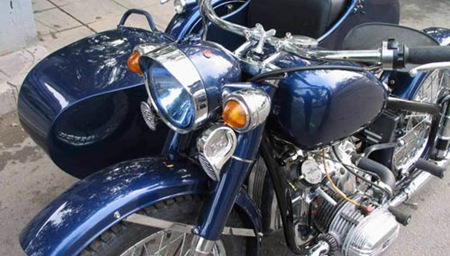
The bikes aren't super fast (they have a 746cc engine creating 24 or 36 horsepower), they leak oil, and you can't ride them on the freeways in Beijing, but I think they're just plain cool. (I'm torn between the charcoal grey and the deep blue. Of course, black just looks great too.) Plus, since they're older than thirty years old, you can export them back to the US afterwards. I just need to convince myself and the family this is a good idea...

Deep blue CJ750

There are quite a few websites on these motorcycles. Here are a few I found useful and seemingly trustworthy.

Community: CJ750.org

Shops:
Big Bill's Bikes aka ZMW
Jimbo's Classic Sidecars
Beijing Sidecars

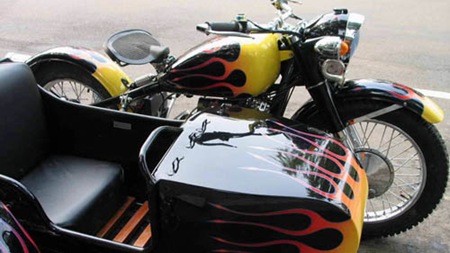
Black CJ750 with red and yellow flames

(All photos from cj750.net -Big Bill's)

Lovely and Delicious Beijing Restaurants: Green T. House Living

  • Published Date:
  • by
  • Category:

This is the third of three articles on great Beijing restaurants in beautiful settings. The others are Duck de Chine and Maison Boulud a Pekin.


Green T. House Living

Although we've had Green T. House on our list for a while, Michelle and I stumbled upon it one afternoon as we were exploring a village near our house. This striking, all-white, airy restaurant is set at the back of an industrial-area-turned-art district near Hegezhuang Village in Shunyi (the suburby/farmy area east of Beijing where we live.) It's hidden behind all-white walls and centered in a field of white pebbles; the sidewalk to the building skirts the outside edge of this field.

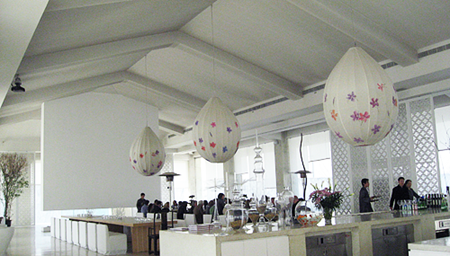
 Interior photo of the Green T. House Living restaurant.

The food is innovative Chinese with European fusion elements. For instance, we had an amazing baked eggplant dish topped with Parmesan cheese (a great match, actually) and colorful steamed man tou (buns) with a pesto dipping sauce (also lovely). The names of some of the dishes are fun too, like "Have you been in contact with fowl in the last seven days?" (a great dish with spicy chicken bits in deep fried tea leaves.) The wine list is also good (if pricey); the cocktails were OK. Service is very good and the staff speak English well. The menus are in English and Chinese.

They're building a bathhouse (spa?) behind the restaurant and will soon start to have tea tastings as well, which should be good. There's a Green T. House in Chaoyang too, which is apparently all black. We'll have to get over there too.

Address: No. 318 Cuige Zhuang Xiang, Hege Zhuang Cun, Chaoyang, Beijing +86-10-6434-2519