A Comparison of US vs. Chinese News Coverage: Pollution
I've written twice before, comparing Western and Chinese news coverage of the same story (Obama visit to China and Internet registration). In both cases, it was interesting to see how the reports read very differently despite presenting the same basic facts; differences in tone, emphasis, and inclusion/omission of other facts can really change how the story comes across.
Today, I was reading about how Beijing will start reporting a new air pollution measure – PM 2.5 (2.5 micron particulate matter). I've written before several times about the gross Beijing air. We relied on the US Embassy's air quality Twitter feed that showed what we thought was a more accurate view of what we were seeing outside; Chinese official reports measured the larger PM10 particles and would say we were having only minor air pollution even when we couldn’t see outside.
The report from China Daily acknowledges the dangers of PM2.5 and how the government is responding to "public criticism". They describe the effort as similar to what other cities in China have been doing and that the government is already taking action to clean up Beijing air. There is no mention of the US Embassy's Twitter feed. There is also a story (higher on the front page) describing how Beijing's PM 2.5 count is down. The story paints a picture of the government taking action and listening to the people. "Beijing to release PM 2.5 data".
The similar story from the New York Times described the actions as a response to "public outcry", "public's anger", and bloggers who "sharply criticized" the government. NYT puts a lot more emphasis on the effect of the US Embassy Twitter feed as well as mentioning how Twitter is blocked in China, and talks about the Chinese complained about the feed as "confusing" and "insulting". This story leaves the reader thinking the people are mad at the government and that the gov't needs outside pressure to change. "China to Release More Data on Air Pollution in Beijing".
Again, both of these stories seem factually correct, and perhaps the "right" interpretation is somewhere in the middle. You'll never know unless you read multiple news sources.
Get Fresher Eggs: Reading Egg Cartons
To find the freshest eggs at the supermarket, you can decode the numbers on the carton. The number we’re looking for is the three digit number (circled in red below). This is the ordinal date (the day of the year) the eggs were packaged (so 1 is January 1, 2 is January 2, etc.) Assuming the eggs were all handled the same way, I think you can assume that eggs packaged more recently are fresher.
Interestingly, the “use by” by date (the month/day indicated on the carton) seems less reliable. These two cartons in my refrigerator have the same packing date yet the “use by” dates are more than a week apart. In my local grocery store, I’ve seen packaging dates more than three weeks apart on the shelf. While the eggs are probably all safe to eat, I’m confident there’s a big drop in quality between these eggs. (I look for how thick/runny the whites are.)
In case you’re curious, the Pxxxx number is the plant where the eggs were packed.
Michael’s Snowman Army
Most kids like making and decorating Christmas cookies. Michael (11) decided he would create an army of snowman cookies instead.
As he was stamping them out, he kept calling, “Rise my minions!”
Once they were baked, he decorated them in red sugar and dubbed them his “Red Snow Corps”. He seems innocent enough in the photo below, but it’s like having our own little Calvin.
Best Sandwich Ever: Katsu Burger
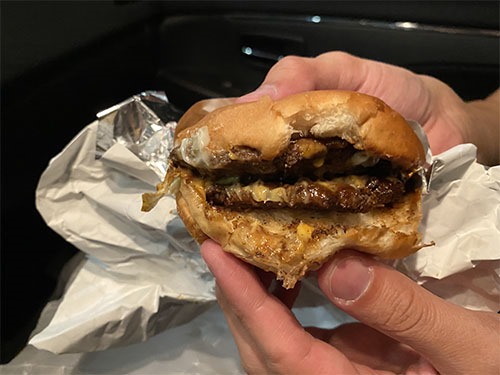
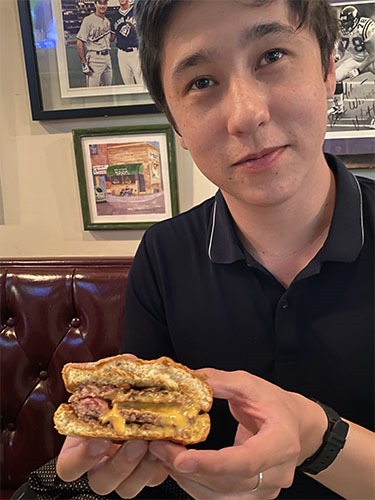
Michelle and I went with our friend Meng to Katsu Burger this week. Like it’s name implies, this little restaurant in the south part of Seattle (Georgetown) serves a unique katsu sandwich on hamburger buns. If you’re not familiar, katsu is a Japanese dish: pork cutlets in panko coating, deep fried.
They have a bunch of different sandwiches including beef burgers and chicken burgers; they even have a ridiculous “Mt. Fuji” burger with a katsu patty, a beef patty, a chicken breast, ham, bacon, and three types of cheese. I passed on that heart-attack-in-a-bun and had a spicy curry katsu burger. Meng had a katsu burger with bacon (my next trip...) We added fries (mine with curry powder, Michelle’s with nori) and a green tea milkshake.
It was really an insanely great meal. I’ve had katsu in famous places across Tokyo, but the katsu at Katsu Burger is among the best I’ve ever had. The burger was crazy good as was the shake. The fries were decent too (they could have been crispier to my liking.)
We waited a while for our burgers (definitely worth the wait), and it looked like you could wind up waiting for a table too. The only real bummer is that Katsu Burger is only open on weekdays.
6538 Fourth Ave. S., Seattle
206-762-0752
[Update 12/23/2011: We went back today and learned that after the New Year (2012) they will be open Saturdays 11-4!! Wahoo! Also, I learned their panko coated, deep fried hamburgers are silly good too.]
WTF Michael
The kids have recently discovered that Michelle's car audio system will read text messages out loud. As you might guess, this has become a source of some amusement.
Andrew (14) has contented himself to making the car say funny things like "blarg" or having it repeat the prompts, but with errors, so it sounds like the car has a problem.
Michael (11), as usual, is more devious. When he sent "LOL" to the car, it said the expanded version "laughing out loud". Without missing a beat, he sent "WTF".
Fortunately, the engineers at Volkswagen had the foresight to handle this case gracefully...
Halloween 2011
The boys chose their own Halloween costumes this year. I thought their choices were pretty good illustrations of their differences. Andrew (14) chose to be a Dalton Academy Warbler from the TV show Glee. (This is a singing group from an all-boys' school.) Michael (11) chose to be an elite soldier from some unspecified armed service. Both were very pleased with their costumes.

Incidentally, Michelle made Andrew's jacket (and one for me...). I thought it turned out really well, better than other jackets I've seen on the net. I found the Dalton Academy patch on Etsy (I've also seen people selling them on eBay). The red piping was seam tape ironed on with heat activated tape (I can't remember what you call it, but you can find it in fabric stores.)
The Intergalactic Nemesis
Last weekend, Andrew (14) and I (much older than 14) bought tickets for The Intergalactic Nemesis, self-described as a "live-action graphic novel". It turned out to be a super-fun performance combining a 1930's-style comic book projected onto a large screen with a old-style radio show performed live in front of the screen by three actors, a Foley (sound effects) artist, and a keyboard player. The evening was even nicer since they performed in the Neptune Theater, an lovely old theater near the University of Washington (Andrew was at least as impressed by the Neptune as the show).
The story was fine and the comic book art OK, but the live performance was really the show for me. The three actors did all of the many voices and were physically into it as well; it was super fun just watching them. The Foley artist was really fun to watch too, just seeing how he created all of the sounds from different things, some purpose-built (like a mini-door and frame for open/close door sounds) and some just ordinary things (like a locomotive engine sound made by shaking a box of macaroni and cheese).
This Austin-based group is touring the country. Unfortunately, they only had one night in Seattle (their first stop), but if you're in Fort Worth, Lawrence, Madison, Chicago, Minneapolis, or one of the other cities they're playing, I really recommend going to see them.
(Interestingly, the "book 2" of the project is a Kickstarter project.)
My bad cameraphone shot of the performance
Andrew taking the mike after the show 
China in Ten Minutes
Of course, it's ridiculous to think you can understand China, the history, culture, and economy in even ten years, but this video does a pretty good job in ten minutes (with lots of gross generalizations, etc...)
Bacon Salted Bourbon Caramel Apples
How can one recipe have so many of my favorite things in it? Bacon with bourbon, caramel, and apples? Awesome. It's probably too much to ask (and too gross) to add raw oysters, ramen, and jiaozi. Roasted nuts, however... I'll have to try this out.

Ingredients
8 Granny Smith apples
8 wooden sticks
1 (16 ounce) package brown sugar
2/3 cup dark corn syrup
3/4 cup water
1 tablespoon Bacon Salt
2 tablespoons bourbon whiskey
Directions
Insert wooden sticks 3/4 of the way into the stem end of each apple. Place apples on a cookie sheet covered with lightly greased aluminum foil.
Combine sugar, corn syrup and water in a large saucepan and bring to a boil over medium-high heat. Reduce heat to medium-low and simmer until thermometer registers 290 degrees F (143 degrees C). Remove from the heat and stir in the bourbon if desired.
Keep the saucepan over low heat to keep the caramel liquid for dipping the apples. Stir the Bacon Salt into the caramel. Working quickly, carefully dip apples in the caramel. Place apples on the greased aluminum foil until coating has cooled and hardened.
From: http://www.jdfoods.net/recipe/1086/Bacon%20Salted%20Bourbon%20Caramel%20Apples
Why Tones in Chinese are So Important
This is a funny example illustrating why the tones (rising/falling pitches) in Chinese are so important.

These two example sentences are pronounced the same way, as you can see from the Pinyin (English pronunciation guide), but the tones are different.
The first sentence says, "Miss, how much does it cost for a bowl of dumplings?"
The second sentence says, "Miss, how much does it cost to sleep [together] for a night?"
Very different meanings...
Reflections on Apple in My Life
With the untimely passing of Steve Jobs this week, like many people, I reflected on how I've been impacted by his contributions. I never met Steve or even saw him in person, but Apple and Steve Jobs definitely played a big role in my life.
My first programming class was summer school after 7th grade (1981?). We had Apple II computers with black-and-white 9" monitors and 110 baud teletype terminals connected to MECC (Minnesota Educational Computing Consortium). The Apples would overheat, so we'd have to open them up and fan them with their lids, but I didn't care. They were pretty magical. Over the next few summers, I improved my Applesoft BASIC programming and learned 6502 Assembly. (I didn't realize the Applesoft BASIC came from Microsoft and was an amalgamation of the two names.)
We eventually bought an Apple II+ with 48K of RAM, two floppy drives, an Amdek color monitor, and an Epson dot matrix printer. (This was in addition to the TRS-80 Model III we had first; we were definitely the first house of anyone I knew with two computers at home.) My friends and I pirated a lot of software (LockSmith is your friend) and played a lot of games like Loderunner, Choplifter, Castle Wolfenstein, and especially Wizardry.
I moved on to teaching Apple programming at home for $25 for five one hour lessons (maybe it was five two hour lesson); this was big money at the time since I was in ninth grade or something. I also wrote an Apple II database program for my school district to keep track of all of the padlock combinations for the lockers; as a result, I could open pretty much any lock in our school district. I got paid in stacks of floppy disks for this. I also got to borrow the first hard drive I ever saw -- a VCR-sized 5MB Winchester (I think); it was partitioned as something like two hundred floppy drives since the OS couldn't support big volumes.
At Stanford, I was a diehard Mac guy, with my Mac Plus with two 800K floppy drives (I eventually upgraded to a Mac SE with a 40MB aftermarket hard drive -- hot stuff.) I also worked at MicroDisc, the computer department of the Stanford Bookstore. At the time, we were the largest Apple reseller in the world. Senior year, I would borrow the new Mac Portable from the store on weekends. I would work on my programming projects at Denny's, drinking their bottomless coffee for hours. Most people hadn't seen a portable computer before, so I was definitely a trendsetter for the now-ubiquitous laptop-in-coffee shop scene.
I took this Mac experience to my first job Microsoft where I worked on Works for Macintosh 3.0 and 4.0. (I think my name is on one of the mailing labels on the box shot to the right.) I had a nice Mac IIci on my desk, but our developers had the screaming-fast (then) Mac IIfx machines. (I remember being amazed that the MacIIfx basically had two Apple IIs inside just to monitor the ADB ports. We'd come a long way...)
My team also ran the Mac lab where we got to see all of the new Mac hardware before they released. Back then, we had a lot of Macs around Microsoft. Every printer room had Apple Laserwriters as well as HP printers, and a lot of people used Word and Excel for Mac instead of on Windows 3.0 since the Mac versions were better.
I also worked on Microsoft Bookshelf for Mac a few years later. (Much) more recently, I got back into the Apple scene with my team's Bing for iPad project, the first Microsoft iPad application.
Of course, even when I wasn't working directly on Apple products, Apple affected me a great deal. There's no question in my mind that Apple helped make Microsoft better by providing a great competitor. They had (and have) a different approach to making products that we envied, even when they weren't making as much money as we were (things have changed).
So, thanks, Steve, for all you've done for me and my life over the last thirty years. RIP.
Microsoft Campus After 9/11
Like many of us, I think, it's hard to believe it's been ten years since the attacks of 9/11. We got a frantic wake-up call from our friend Steph to go turn on our TV and watch the news because some "crazy shit was going on". We saw the first tower billowing smoke and then watched in horror to see the second plane crash into the other tower. It's still stunning to think about.
I went into the office to make sure all of my team was accounted for (we had people travelling to the East Coast at the time). It was really scary since no one knew if there were other attacks coming, and Microsoft was a relatively high profile US target. Michelle didn't want me to go, and in introspect, I probably should have stayed home with my family. Fortunately, of course, we were OK, and all of the Microsoft employees were safe.
Security on campus changed after 9/11. We've always had cardkeys, but after 9/11 it was mandatory that we wear them visibly, and we stopped being able to receive personal packages at work. These have relaxed a little in the intervening years. However, we still have the required parking permits on our cars that started after 9/11.
Pretty quickly after 9/11, flags went up everywhere, including at our Redmond West campus. Hopefully, we never have occasion to fly the flag like this again.


Mount Rainier
Despite having grown up in Seattle, our kids had never been to Mount Rainier; even Michelle and I hadn't been since before we were dating. It was such a nice day today that I dragged everyone on the long drive to Paradise to check out the mountain. (I had planned to go to Sunrise, but that was an even longer drive.)
Not surprisingly, the mountain was stunning. The wildflowers were in bloom and the sky was clear. Also not surprisingly, it was pretty crowded with a long line of cars trying to get into the parking lot. Note to self: go earlier in the day vs. waiting until afternoon.
The drive was a bit long for a day trip, but I'd love to check out some of the other areas of the park as well as the lovely lakes nearby.
Wildflowers dotted the hillside on the cloudless day: 
Michael (11) checking out the summit from the visitor center: 
The big crowds were the only downer. 
Michelle, Michael, and Andrew (14) in Paradise. 
Rebuilding My Kamado
When I bought my first house (gosh, maybe seventeen years ago?) one of the first things I wanted was a Kamado. These are ceramic barbeque grills, like the Big Green Egg, that can produce almost magical results grilling, roasting, baking, and smoking. Over the past few years I found myself going to the more convenient gas grill, but after my recent BBQ Fantasy Camp, I wanted to try using the Kamado again.
Unfortunately, my Kamado was pretty run down after so many years outside plus a few moves. The metal hinges and cart were rusty, the firebox was cracked, and the paint very faded. Drawing inspiration from netizens in similar situations, I ordered new replacement parts and spent the weekend rebuilding my Kamado.
Here's my Kamado pre-rebuild. You can see all the rust (and rust stains) on the metal parts. The thing under the grill is the cracked grate (usually inside). 
Here's a shot of the cracked firebox inside. 
The faded and peeling label. 
I took the grill apart and repainted the pieces with black spray paint made for use in high temperature applications. (This is easy to find at hardware stores.) The rectangular hole in the red section below is where I took off the old draft door. The screws holding the draft door assembly on were so rusted I had to cut the heads off with my Dremel; this was probably the most time consuming part of the whole job. 
Here's the finished product, with the new hinge band and draft door (at the bottom). I also repainted the wagon and replaced the rusty and bent casters with new ones. Even though I didn't do a great job with the spray paint, I think it looks much better. I ultimately used a little over a can of spray paint for the whole job. I probably should have put a second coat of paint on, but I was too lazy. 
This is the interior with a new firebox and grate (the old ring on top of the firebox was still fine, so I'm still using it.) You can also see the nice new lid gasket. I haven't had a gasket on the Kamado for years after the original one burned off. This one is supposed to be a high temperature gasket that won't burn. We'll see. 
All told, I probably spent about $300 repairing the grill (replacement cost is about $600) and 4-5 hours. I ran out of time this weekend to cook anything in it, so I'm dying to give a whirl.
Ren Faire!
The family and I plus our friends John, Kellie, and Barbi went to the Washington Midsummer Renaissance Faire in Bonney Lake today. This was the kids' first time to a Ren Faire. I think it was Kellie and Barbi's first faire too.
We all had a great time. Almost all of the costumed attendees were very friendly, despite the fearsome looking weapons. These guys practically dragged Andrew (14) over for a photo. 
I got my obligatory Ren Faire meal of a roasted (and smoked!) turkey leg. It was actually quite nice. 
The Academia della Spada offered a pretty interesting overview of how fencing evolved in Europe including this sword and buckler fight. I was surprised how slow and calculating the fights were. This is apparently historically accurate. Going fast makes it easy for your opponent to get around your guard. (Who knew there are historical fencing clubs, let alone multiple in Seattle?!) 
The boys got in on the action too in a massive Boffer sword fight. There were two teams with maybe fifteen fighter per side, armed with soft swords, spears, and shields. There were some simple rules about how you were wounded and died in action. (They'll come out and stage fights for parties! Can you say "morale event"?) The boys both thought this was the best part of the faire. Here's Michael (11) about to leap into the fray. 
We all tried our hand at throwing knives, axes, and throwing stars too. I was pretty terrible at all of them, managing to hit the targets but not getting anything to stick in. Barbi was clearly a ninja in a previous life, scoring the best of all of us on the throwing stars. Here's John releasing his axe. 
All views on this site are mine and do not necessarily reflect the opinion of my employer, family, or any known acquaintances. Besides, who would want to take credit for my looney ideas...